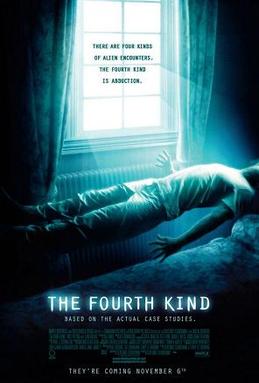
As stated in the Paranormal Activity review, one of the biggest criticisms against these "Faux-Archival Recordings" films like The Last Broadcast or Cloverfield is their use of cinema-verite shooting and editing styles to disguise a low budget and/or inexperienced crew. It's akin to the criticism that most video recordings made of UFOs take advantage of low resolution and shakiness to hide what could otherwise be either a very obvious model or a perfectly normal and natural aerial phenomenon. To that end, The Fourth Kind tries to dispel these potential accusations by taking the bogus amateur footage and juxtaposing it with polished and highly dramatized re-enactments in the tradition of Unsolved Mysteries or America's Most Wanted. This merging of styles should have been the strength of the film. Instead, it tears at the very fabric of cinematic reality itself and exposes the utter incompetence of the director.
The plot of the film centers around a widowed psychologist named Abby Tyler, who's studying the sleeping habits of some of her patients in Nome, Alaska. She's carrying on the research of her husband, who was murdered several years ago while they slept. The good doctor has vague and distorted memories of the event and finds herself unable to clearly recall the killer's face. To further add to her anguish, her daughter is rendered blind shortly after the murder and her son becomes withdrawn and resentful of his mother. Unable to deal with him, Dr. Tyler buries herself in her late husband's work and begins to notice strange similarities in the testimonies of some of her patients. They all seem to have been woken in the middle of the night (around 3am) by a white owl. This owl becomes the last thing these patients clearly remember before they experience memory loss and blackouts. Attempts at using hypnotherapy to uncover these missing hours often results in fanatical panic attacks. Things take a turn for the worse when one of these patients becomes completely unhinged and murders his family before taking his own life, hysterically referencing an enigmatic "them." If you think you can see where the rest of the movie is going from here, there's at least a 75% chance you're absolutely right on the money. After all, when dealing with entities like ghosts or aliens, there aren't many directions the narrative can go; either you keep it vague and bank on the audience projecting their own fears over the gaps, or you come right out with it and turn the whole thing into a creature film. That's not a bad thing, and it's certainly not the low point of the film.
Where the movie fails is almost entirely in the presentation. The film has such a confused sense of its own reality yet tries desperately in spite of this to suspend the audiences' collective disbelief. This is what I like to call an Imperial Failure, which refers to a film that tries to be something more than what it is but has nothing to back up its endeavors with, much like The Emperor's New Clothes, where dignity and royalty are thrust upon the seemingly simple-minded masses in the hopes none of them will notice that the big kahuna's new threads are a birthday suit. Thus, when someone does point out the obvious, er, shortcomings, the whole exhibition falls apart and becomes a laughingstock. In short, there's nothing wrong with trying something new or different, but don't expect the path less traveled to be beyond criticism compared to the path well-worn.
Right from the start, we get our sense of reality thrown into question when Milla Jovovich emerges from a shadowy and out-of-focus forest, approaches the camera, looks the audience dead in the eye, and introduces herself as... herself. She goes onto say that what we are about to witness is based on reported events. She explains how the film will essentially be structured, with archival footage mixed with reenactments, either side-by-side on screen, juxtaposed, or even overlaid (in the case of some of the audio recordings).
If this all sounds like it would be jarringly distracting, completely ruining any sense of immersion, it is. The movie takes great pains to continually remind you that you're watching a reenactment; whenever a new character is introduced, however late into the narrative that may be, a caption appears beneath them giving the actor's name, their character's name, and, where applicable, a notation stating that the character's name is actually a pseudonym to protect the identity of the supposedly real individual.
This double-identity run-around reaches its epitome when the director himself appears in the film as the head of the psychology department at Chapman University, using his real name, which is Olatunde Osunsanmi. This situation is two-thirds true; Chapman University is a real establishment, and Olatunde Osunsanmi is an alumni, but he's not the head of the psychology department, now nor ever. Normally, I'd say, "fair enough" and even call the move subtle to the point of being masterfully crafted. After all, the director is not particularly well-known, certainly not as well known as someone like Milla Jovovich, so appearing to us in the supposed archival footage interviewing the allegedly real Abby Tyler would stand as a kind of subtle, yet finalizing, clue as to the film's insisted authenticity. Unfortunately, subtlety gets thrown out the window when he shows up at the end, in the shadowy and out-of-focus forest alongside Milla Jovovich, and delivers a would-be cryptic message to the audience along the lines of, "believe what you will."
This is the part that speaks to the director's incompetence. Milla can break character because she's part of the reenactment side of the equation, so she doesn't interfere with the archival footage's feigned authenticity. Olatunde, however, is part of the authentic side of the story, the part we're supposed to be fooled by, so when he breaks character (even if it's not that much of a character), he takes half his own movie down with him, leaving the other half twisting in the wind. This makes his pretentious statement of "believe what you will" utterly laughable because his very presence removes all doubt about what we're supposed to believe. People often talk of directors sabotaging their own movies, but few do it in person.
And another thing...
To put it another way, "twisting in the wind" is a charitable assessment of how the film's other half fares on its own.

