Showing posts with label audio. Show all posts

19 July 2026

Waiting for the Gift of Sound and Vision

One of my favorite means of indulging my nostalgic needs of late is to peruse old gaming magazines that I had read in high school and some of college, late 90’s to early 2000’s. This is easy enough thanks to sites like Retromags and the Internet Archive. The scan quality isn’t always great and there’s a few gaps here and there, but the fortunate part about what I was looking for most recently is that advertisements tend to repeat month to month. If you’re very lucky, what gets advertised eventually gets featured in the magazine proper.

I don’t consider myself an audiophile. I don’t know enough about speakers to know my studio monitors from my bookshelves from my ribbons from my… whatever the speakers I was looking for are, but I know enough to know what sounds good to me. One thing I’ve learned over the years is that with the possible exception of the iPhone, the internal speaker on any electronic device is bound to be terrible. If you’re lucky, it’s terrible in a way that makes it good. The speakers in my PSP would crackle a little when sound peaked, such as during an explosion or a crash of some vehicle, but I found something oddly satisfying and reassuring about it. I know charm is an overused term, but I can’t think of a more apt term for this particular flavor of the warm and fuzzies.

Sidenote: we had our N64 hooked up to a TV whose internal speakers weren’t shielded from the cathode ray tube. Before I understood anything I just said, I was convinced the screen flickering during loud parts or bass-heavy sounds was the awesome power of the artificial intelligence written into the game’s code. The system (and specifically Shadows of the Empire) was just too damn powerful for our meager little television set.

Maybe I don’t read enough magazines, but it always felt like the ads in videogame magazines were especially creative. They were bold, edgy, funny, clever, and memorable enough that I found myself looking back through those old issues for a set of Sony speakers I saw advertised in an issue of Electronic Gaming Monthly. The ad was two pages, but it wasn’t a spread like you’d expect. The first page was a tall, narrow, black speaker with a few buttons and a green slit of an LCD. Its cord ran out from its back and to the right of the page. A few pages later, the second page showed the speaker’s mate, its own cord running in the opposite direction. The first page asks if you need a reason to get surround sound, advising you to keep flipping the pages. The second page observes that you’ve seen no shortage of reasons. A few more buzzwords about the quality of the speakers and an image of how the speakers are intended to be set up, with one on either side of a modestly-sized television. 


I think I was fascinated by these speakers, blandly branded the SA-VA7’s, because they didn’t fit any conventional models of audio setups I was superficially familiar with. It mentioned surround sound, but in my experience, surround sound required more than two speakers and they all had to be hooked up to a massive receiver under your VCR and/or DVD player. These looked more like the speakers you get for a PC, but they were so much bigger and imposing looking. Too insubstantial for the former and too over-engineered for the latter, I think the reason I didn’t inquire further into them was that I doubtless couldn’t afford them, be they a cheap surround system or an expensive PC speaker. Moreover, I already had a really nice stereo system that I’d gotten unexpectedly for Christmas, so they’d be redundant as well.

Sidenote: It’s worth pointing out here that I can be an exceptionally frugal person. My brother likes to tell this story about the time he asked me, “If you could have any car in the world, any at all, what would it be?” My response was a Geo Storm. He thought for a moment and explained that cost wasn’t an issue, that it could be any vehicle regardless of price. I stuck to my guns. In those decades since, my taste in cars has become more high roller than coupon-clipping, and I’ve also learned to distinguish between purchases and investments.

A few years later, something unexpected happened. The family computer, a Bondi-blue G3 iMac with a DVD drive, became my computer. This meant it wound up in my room on my desk, against the opposite wall of my TV, Playstation, and stereo. Obviously, hooking up my TV and Playstation to the stereo was easy and straightforward. If I wanted to hook my iMac to the stereo, I would have had to run a cord from my desk and across my floor to the entertainment center. Even if I wanted to deal with the tripping hazard, there’s the problem of the speakers being behind me while I’m at the iMac at my desk. In fact, they were behind me and to my left, so it was far from an ideal arrangement.

Along comes another issue of Electronic Gaming Monthly and with it the solution to my problem. If SA-VA7 was a bland name, these had the exact opposite problem. These had at least two names and from a brand that seemed to be in the process of restructuring, so there were two additional names. The full title of these little dynamos was the ScreenBeat Sound Station by SpectraVideo/Logic3. The apparatus consisted of two small speakers wired up to a subwoofer that was meant to sit on the floor (or on your desk if you wanted to the Jurassic Park thing with any cups of liquid you had). This made it what’s known as a “2.1” sound system, with the decimal referring to the subwoofer as that’s generally less something you hear and more something you feel. They retailed for about 70USD (I never found out what the SA-VA7’s cost) and their absolute best feature that stood out to me: they matched my iMac


It wasn’t a perfect color match, but close enough that, when I moved into my college dorm, my roommate’s dad asked if I was a computer science major. When I said I wasn’t, he asked about the tower I was setting up under my monitor. I explained that the monitor was the whole computer and the “tower” was just a speaker. That shows you how revolutionary the design of the iMac was; beige boxes were still the industry standard. The elaborate, Windows-based gaming rigs you see today were around, but they were almost rarer to see in the wild than an iMac. Simply put, it seemed like these speakers were made just for me.

A lot of time passed, I graduated college, the iMac was getting a bit long in the tooth in term of technology (and it was already admittedly a little bit underpowered for anything outside of video editing in Quicktime Pro, writing papers, making Powerpoint presentations, and simple 3D modeling in Poser), and Windows XP had fixed pretty much every complaint I ever had about previous offering from the House of Gates. So, the iMac went away and my proper PC tower became my monolith to all things media and productivity. The ScreenBeats had gone away somewhere in this timeframe, either before I graduated or just after, and I mostly stuck to using headphones if I was going to be immersed in whatever I needed the PC for.

A lot more time passed and the most elaborate sound system I had was a speaker bar for my TV and game consoles. If I was using a computer or a phone or a tablet, headphones were my default. They were also the default for when I listened to music as I was in an apartment and I didn’t want to be THAT neighbor blasting music through my speaker bar. Of course, I watched plenty of movies and played plenty of games through that speaker bar, but that just seemed different to me somehow, like it would be more forgivable or bearable than going through the entire Daft Punk discography. Also, my roommate has little to no concept of an indoor voice when she’s gaming on her PC and headphones were the best defense.

Toward the end of my time in that apartment, I was watching a YouTube video from a games reviewer named Caddicarus. This particular video was sponsored by a company called KOVE and the product on display was a cylindrical Bluetooth speaker that fit nicely into the cupholders of a car, likely hence its name of the Commuter. When I checked out the website, I saw KOVE had a new speaker on offer called the Commuter 2 (which they changed recently to a "K"), the sequel to the speaker I’d just seen. If you’re in the market for a Bluetooth speaker, KOVE is a little hard to recommend. I think they’re a drop-shipping operation. That is, KOVE is the branding middleman for a generic speaker you can probably find cheaper elsewhere under a different name. It’s also one of those sites that is running flash sales all the time, so it’s virtually impossible to pay the full advertised price for the speaker. I know there’s a name for this advertising tactic, but I can’t be bothered to look it up. Needless to say, the speaker was cheap despite being advertised on a massive sale, but like those iMac matchers from years ago, they had a little special something to them that intrigued me. I took the chance and got my 200USD speaker for a mere 64 (which is technically less than what I paid for the Sound Station if you consider inflation). 


The intriguing feature was the ability of the speaker to split into a stereo pair. It twisted in the middle with a bayonet-style locking system and this middle seam was actually angled in such a way that the two halves would rest with their drivers aimed slightly upward. 


Did I think this was an absolutely inspired piece of design? Very much so. Did I ever actually use it when I was writing on my iPad with my little keyboard and case that folded into a stand for the iPad? Maybe once. I mean, I wasn’t about to set this up in a coffee shop. An especially clicky mechanical keyboard? Yes, I’m THAT guy. Speakers? No, that’s just plain obnoxious. 


I ended up giving the speaker to my roommate. It wasn’t a hard decision because, despite the intriguingly cool design, the KOVE Commuter 2 had a crippling flaw: latency. If you were simply listening to music or an audiobook or a podcast, there was no issue. If, however, you were watching a video, you’d notice a bit of a gap between the lips flapping on the screen and the sounds hitting your ear. If you were using a music-making app like GarageBand or a digital instrument of some kind, forget it. It was at least a full beat behind, making it practically unusable. I have no idea why it has this problem; I don’t have this issue with Bluetooth headphones. My best guess is it’s something to do with the way the two speakers are tethered together, since you’re still only connecting one speaker to your source. It must simply be too much number crunching to receive the signal from the device and then beam the other channel to its mating half. Maybe this is why I’ve never seen another Bluetooth speaker like this one, why I don’t see this stereo splitting by other companies like SONOS or JBL.

As for replacing my KOVE, I came across a slender little number from Sony, the SRS-XB23. It didn’t split in two, but could still play a stereo signal through its two drivers, requiring you to place the speaker on its side for best results. I paid roughly less than the Commuter 2, it fills the room quite nicely, and there’s no latency when I’m watching something on my phone or making music.

A few weeks ago, I was thinking about those old SA-VA7’s from the magazine ad and did a little investigating. I found exactly one YouTube video of someone showing them off, along with some scattered pages in various audiophile databases. Overall, they don’t seem to have sold very well, which may be attributed to Sony marketing them to gamers to use with their Playstations. If gamers are going to hook up their consoles to a sound system, they’re probably just going to do what I did and use the one I had for music anyway. That was when an idea hit me. The SRS-XB23 may not have had the ability to split into two speakers, but there is a feature that plays right into the devious marketing of those bigger audio equipment companies like JBL or Bose: Stereo pairing.

It’s simple enough in principle. If you have two of the same model of Bluetooth speaker, you can pair them together so that one is the right channel and the other is the left channel. This is the “that’s where they get you” of the scheme. Why sell one speaker that does the work of two when you can have two speakers at twice the price? The SRS-XB23 had been out for a few years and was still available as New Old Stock on Amazon. In fact, I got it from the same third-party seller for about the same price.

Although simple enough in principle, actually setting up the stereo pair is a little bit tedious. For starters, I’ve already got one SRS-XB23 saved in my phone’s Bluetooth settings, so now there’s another identical speaker to add to the mix and I can’t just nickname them like some other devices. Secondly, you’ve got to pair the speakers with each other first, which means you have to turn off Bluetooth on the device you’re ultimately going to tether them to. Tedious may be a strong word, but it’s not very intuitive and certainly not discoverable without consulting an online guide. Once you’ve got the stereo pair sorted, each speaker conveniently announces whether it’s the left or right channel. Finally, you turn the Bluetooth back on your device and hope you pick the correct of the two identical speakers and you’re off to the races in stereo and with no noticeable latency.

Am I going to use this setup? No. I don’t do a lot of writing on my iPad anymore since I’ve got a recently upgraded desktop setup that I plan to get as much use out of as humanly possible. As for using them with my desktop (music coming from my iPhone and to the speakers) my monitor is too wide and my desk is too narrow to place them at each side as intended. Did I waste my money? I don’t think so. I’ll still use the stereo pairing on occasion. They sound great in tandem, plus I’ve got one as a backup given the first is almost 5 years old at this point and with semi-regular use. Most importantly, after 30-some years, I finally have (the option for) two tall, narrow Sony speakers on either side of a display.

25 February 2014

A 1300USD Textbook

And Further Proof of How Boring I Am

Many, many years ago, I visited my brother and his wife when they were living in Arizona where she taught French to spoiled, bratty rich kids whose parents clearly knew they weren't cut out for Ivy League despite being able to afford it. While there, we went to a museum showcasing the treasures of China's Forbidden City. It was a very nicely laid out, extremely fascinating exhibit, helped in part by something I'd never heard of before called an audio tour. 
In the old days, some displays would have these weird telephone receivers on hooks in front of them. They didn't have microphones, only the earpiece. You held it to your ear and listened to a looped recording of a narration. Now, depending on the exhibit, you get a small MP3 player with a number pad on it. Each display has a number on it, and entering that number plays a relevant track. I remember being so fascinated by this I wrote down the name of the company branded on the player. I may have visited the site once, but it was years ago and I've forgotten the name of that specific manufacturer. 
However, if they folded, it was likely by competition, because now a simple search for "audio tour" yields a number of service providers. Apparently it's become the norm. It even has a Wikipedia page. It seems a bit sad that a tour guide has been replaced by a machine, but at least it's still a person making the recording, and you're not navigating around herds. 
Obviously, this is a very commercial idea, keeping tours as efficient as possible to cut back on crowding and increase turnaround in patronage, but anything that starts commercial can always have an artistic, more personal touch applied to it. It's how any artistic medium starts. I went to the Wikipedia article and found an article under Further Reading entitled, "Speeches of Display: Museum Audioguides by Artists" by Jennifer Fisher. Sounds like exactly what I'm after, I thought.

ISBN: 0920397808

It is a textbook that costs over 1000USD. The used price is around 200USD. 

The individual article, luckily, is only 6USD. 

31 March 2012

Alesis Videotrack (Build Quality & Accessories)


Follow up to my Camera Complaint video, wherein I explain
the rather poor audio quality. Interestingly, it's not because
the microphones were of poor quality, but rather because I
was standing on the wrong side of the camera.

08 November 2011

A Question for YouTube (quasi-s.978/copyright related)

I'd never heard of this until a YouTube partner by the name of The Archfiend pointed it out. Apparently, a common (or once common) trend on YouTube was for people to post a comment, either on a video or a user's channel page, to the extent of "Sub4Sub" meaning, "If you subscribe to me, I shall return the favor."

For reasons that probably shouldn't have to be explained or explored in any great detail, this is really annoying, unfair, and, in the case of those asking, downright pathetic. Put simply, their channels are so bad, so borderline invisible, and so obnoxiously underwhelming that they have to ask people to subscribe to their channel in exchange for their pretend patronage.

Luckily, YouTube, in a moment of genuine interest in the goings-on of their site, decided this had to stop, and not only said as much, but literally found a way to prevent it. Now, if someone types "sub for sub" or anything along those lines, the comment does not post. The pathetic excuse for a human being begging for attention will get an error message that the comment cannot be posted due to an "internal error" which is a polite way of saying, "Get a damn life, you scum-sucking bottom-feeder." This technology isn't actually new, as many web-hosting services and a few online games have filters in place that seek out specific words and either erase them, or replace them with something else. It's typically reserved for obscenity and various foul terms, but YouTube has discovered it can also be used to keep people from mooching off of others. Again, genius.

YouTube also has a program that can "listen for" copyrighted music in videos and either mute the video or, as is more often the case, send you an e-mail asking if you'd like to allow a link to a legitimate download service (like iTunes or Amazon) to be posted alongside your video. Of course, it's not really a question, just a kind of gentle warning. They'll only post the link if they can actually get the rights to the song, otherwise they go with the muting option. In essence, they're trying to work with you, reach an agreement of sorts with the record labels so they don't take you to court for all you're worth plus interest. I've always felt the "free publicity" defense often used by people who use copyrighted music illegally in their videos is incredibly weak, tantamount to the spoiled child throwing a temper tantrum and screaming, "You never loved me!" but somehow YouTube has found a way to make it work. I may not approve of a compromise like this, but that's not the same as opposing it.

And yet, despite these capabilities at YouTube's disposal to help both its community and entertainment providers, I still see users posting full movies either in parts of around 10, or even, with the recent set of site changes of late, in single uploads. Granted, with the way the DMCA works, YouTube can't officially make a move against the offending user unless the original copyright holder files a formal complaint, a condition I consider akin to taking someone's car keys and throwing them in the river, insisting that it is not grand theft auto as the car is exactly where it was when the owner originally parked it and no one else has the keys. YouTube has created a kind of relatively safe haven for people to post videos that are not their own yet claims total immunity for what people do with it. Fair in principle, possibly, but jury's out on the practice. The point is, if they're willing to actively work and cooperate with record labels before any legal paperwork is filed, and set up parameters that flag comments for spam, why isn't there a means for automatically flagging videos that are of full-length feature films? Where's the misgiving about what exactly is going on with that user's channel? Sure, clips are tough to peg down as offending because they're only a short portion and often given at least a little context, such as hosting the video on a weblog for review or critique and putting a link to the journal in the description. Exhibiting the film in full, however, hardly counts as fair use, regardless of any attached analysis.

Copyright is far from a black and white issue, but it's not a complete gray area, either.

15 August 2010

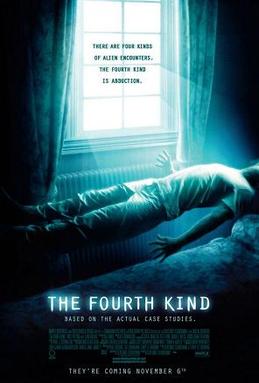
The Fourth Kind... of Worst Movie of All Time


As stated in the Paranormal Activity review, one of the biggest criticisms against these "Faux-Archival Recordings" films like The Last Broadcast or Cloverfield is their use of cinema-verite shooting and editing styles to disguise a low budget and/or inexperienced crew. It's akin to the criticism that most video recordings made of UFOs take advantage of low resolution and shakiness to hide what could otherwise be either a very obvious model or a perfectly normal and natural aerial phenomenon. To that end, The Fourth Kind tries to dispel these potential accusations by taking the bogus amateur footage and juxtaposing it with polished and highly dramatized re-enactments in the tradition of Unsolved Mysteries or America's Most Wanted. This merging of styles should have been the strength of the film. Instead, it tears at the very fabric of cinematic reality itself and exposes the utter incompetence of the director.

The plot of the film centers around a widowed psychologist named Abby Tyler, who's studying the sleeping habits of some of her patients in Nome, Alaska. She's carrying on the research of her husband, who was murdered several years ago while they slept. The good doctor has vague and distorted memories of the event and finds herself unable to clearly recall the killer's face. To further add to her anguish, her daughter is rendered blind shortly after the murder and her son becomes withdrawn and resentful of his mother. Unable to deal with him, Dr. Tyler buries herself in her late husband's work and begins to notice strange similarities in the testimonies of some of her patients. They all seem to have been woken in the middle of the night (around 3am) by a white owl. This owl becomes the last thing these patients clearly remember before they experience memory loss and blackouts. Attempts at using hypnotherapy to uncover these missing hours often results in fanatical panic attacks. Things take a turn for the worse when one of these patients becomes completely unhinged and murders his family before taking his own life, hysterically referencing an enigmatic "them." If you think you can see where the rest of the movie is going from here, there's at least a 75% chance you're absolutely right on the money. After all, when dealing with entities like ghosts or aliens, there aren't many directions the narrative can go; either you keep it vague and bank on the audience projecting their own fears over the gaps, or you come right out with it and turn the whole thing into a creature film. That's not a bad thing, and it's certainly not the low point of the film.

Where the movie fails is almost entirely in the presentation. The film has such a confused sense of its own reality yet tries desperately in spite of this to suspend the audiences' collective disbelief. This is what I like to call an Imperial Failure, which refers to a film that tries to be something more than what it is but has nothing to back up its endeavors with, much like The Emperor's New Clothes, where dignity and royalty are thrust upon the seemingly simple-minded masses in the hopes none of them will notice that the big kahuna's new threads are a birthday suit. Thus, when someone does point out the obvious, er, shortcomings, the whole exhibition falls apart and becomes a laughingstock. In short, there's nothing wrong with trying something new or different, but don't expect the path less traveled to be beyond criticism compared to the path well-worn.
Right from the start, we get our sense of reality thrown into question when Milla Jovovich emerges from a shadowy and out-of-focus forest, approaches the camera, looks the audience dead in the eye, and introduces herself as... herself. She goes onto say that what we are about to witness is based on reported events. She explains how the film will essentially be structured, with archival footage mixed with reenactments, either side-by-side on screen, juxtaposed, or even overlaid (in the case of some of the audio recordings).
If this all sounds like it would be jarringly distracting, completely ruining any sense of immersion, it is. The movie takes great pains to continually remind you that you're watching a reenactment; whenever a new character is introduced, however late into the narrative that may be, a caption appears beneath them giving the actor's name, their character's name, and, where applicable, a notation stating that the character's name is actually a pseudonym to protect the identity of the supposedly real individual.
This double-identity run-around reaches its epitome when the director himself appears in the film as the head of the psychology department at Chapman University, using his real name, which is Olatunde Osunsanmi. This situation is two-thirds true; Chapman University is a real establishment, and Olatunde Osunsanmi is an alumni, but he's not the head of the psychology department, now nor ever. Normally, I'd say, "fair enough" and even call the move subtle to the point of being masterfully crafted. After all, the director is not particularly well-known, certainly not as well known as someone like Milla Jovovich, so appearing to us in the supposed archival footage interviewing the allegedly real Abby Tyler would stand as a kind of subtle, yet finalizing, clue as to the film's insisted authenticity. Unfortunately, subtlety gets thrown out the window when he shows up at the end, in the shadowy and out-of-focus forest alongside Milla Jovovich, and delivers a would-be cryptic message to the audience along the lines of, "believe what you will."

This is the part that speaks to the director's incompetence. Milla can break character because she's part of the reenactment side of the equation, so she doesn't interfere with the archival footage's feigned authenticity. Olatunde, however, is part of the authentic side of the story, the part we're supposed to be fooled by, so when he breaks character (even if it's not that much of a character), he takes half his own movie down with him, leaving the other half twisting in the wind. This makes his pretentious statement of "believe what you will" utterly laughable because his very presence removes all doubt about what we're supposed to believe. People often talk of directors sabotaging their own movies, but few do it in person.

And another thing...


To put it another way, "twisting in the wind" is a charitable assessment of how the film's other half fares on its own.