Showing posts with label comics. Show all posts

08 August 2016

BATMETA: 1-2 Punchline

Destiny of the Daleks is a classic Dr. Who episode that may credit Terry Nation as the writer, but has a slightly more patchwork sort of genesis. While much of what went on behind closed doors has remained obscured, the main bullet points are as follows: Terry Nation wrote Destiny but only as a first draft. Historically, Nation's first drafts ended up as his finals with only the most minimal tinkering from the producers and script editors. However, due to various goings-on in Nation's life, the draft he turned in turned out to be uncharacteristically short on length, to such a degree that what dialogue was written had to be completely re-written around the new material. Effectively, script editor Douglas Adams had to recapture the bottled lightning of City of Death by taking a barely-there plotline and building up an entirely new arc on top of it. The result is an odd synergy of two equally talented but extremely different writers. Nation is no-nonsense. Adams is all about nonsense. Nation is a man of extremes, lots of betrayals, bombs, invasions, and perils. Adams reads between the lines and then the lines between those, then re-works them into a kind of Dadaist tableau of metaphysical causality... usually involving towels. 
It's all rather like watching a car crash in slow motion... through a fireworks warehouse... on the hottest, driest day of the year... when the sprinkler system is out... while the Firebird Suite blasts out of a wall of Marshalls, the whole event finally ending with the stunt driver climbing out of the vehicle and yelling, "Tah-Dah!" at the top of his lungs before his legs give out from exhaustion. He was supposed to deliver a pizza, but we're nonetheless impressed at the spectacle that unfurled before us. 

Now that the prologue is out of the way, let's talk about the prologue of The Killing Joke, and the dynamic between Alan Moore and Bruce Timm. 

The Killing Joke is a 1988 one-shot Batman story written by Watchmen creator Alan Moore, offering a proposed origin story for the Joker, complete with a psychological analysis from our unreliable narrator, the Clown Prince of Crime as he torments Commissioner Gordon after shooting his daughter Barbara through the spine. Though the influence of the book is still being mapped out to this day, sometimes we have to call a spade a spade. 

It's not an especially good story...

And I can say that because even Moore has expressed embarrassment over the piece. The biggest criticism that could be leveled at the story (as well as the recent animated adaptation) is that it's a victim of its own hype. It leans heavily on pure shock value, disguising an otherwise humdrum story from a writer with a reputation for breaking the mold with spectacular flair. Remember, Watchmen and The Dark Knight Returns had already happened three years earlier, so the public perception of Batman (and comics in general) had already shifted from juvenile camp and fun to the big leagues of pathos and tragedy. Had it been released earlier, or in lieu of either of those two other works (unlikely, as Dark Knight was Frank Miller's work), maybe it would have had a better chance. 
Similarly, Bruce Timm has had his own run-ins with using shock value to move up from the kid's table, once again causing a ripple still being felt today. When Batgirl came to Batman: The Animated Series, Timm didn't simply want to tick off a box of Batman staples, and he certainly didn't wish to emulate the Yvonne Craig Batgirl of the Adam West show, who, among other silly compromises, was never actually allowed to punch anybody. Furthermore, he wanted to make Batman a tragic figure in every aspect of his life. This included his already tumultuous romantic life. 

Two birds plus one stone equals five words: No dating at the office. 

This is where we have to delve into a slightly (read: very) uncomfortable discussion of eating one's cake and having it too, that of presenting drama and tragedy but somehow not tugging at heartstrings or turning stomachs. Storytelling 101 tells us any good story needs conflict, bad things need to happen to good people, giving them a challenge to overcome and possibly undergo a drastic change as a result. 
Gail Simone found that, more often than not, the tragedy tends to fall on female characters, to an alarmingly disproportionate degree. This is a phenomenon dubbed Women in Refrigerators, a reference to an issue of Green Lantern in which the titular guardian discovers his girlfriend's murdered corpse stuffed in his refrigerator, signaling the return of an old enemy. Put simply, in the opening act of The Killing Joke, Barbara Gordon is refrigerated. She is shot in the spine by the Joker right in front of her father, who is subsequently taken away to be psychologically tormented, all as a means to lure Batman into a final confrontation. 

Here's my personal stance on the whole issue of how female characters are (mis)treated in comics: It is most certainly a problem, but not because it's sexist or misogynistic or any other problematic adjective. It is a problem because it is lazy, tired, cliched, and overdone. On top of that, the only reason I care is because comic publishers keep complaining about how they want to expand their audience to include more female readers, only to keep giving their identifying characters the short end of the stick and beating them unconscious with it. 

For the record, I do not consider Timm's idea to romantically link Batman and Batgirl to be a bad one. In fact, I think it is pure, artistic genius, even brave. That said, I'm going to attach a very big qualifier to that statement:

In a vacuum. 

In the context of a mid-90s animated series generally aimed at a younger audience about a popular comic book hero still shedding the stigma of camp, the notion of Batman as a tragic figure by way of his most stable relationship being with his best friend's daughter, is brilliant. Timm has even said, when asked why the odd pairing that's most certainly bound to fail, "That's why we did it." If it's not clear yet why I'm madly in love with this bad romance, let me put it this way: Where is it written that every relationship in any story has to go well? Hell, George Lucas even asked once why every male and female lead have to end up together. For as much of a headache as it seems to be for comic writers to write superheroes as married, they seem to have a harder time writing a relationship that's got red flags from the word go. Of course it's not going to work. Of course it's going to end badly. Of course it's likely to backfire in the worst conceivable way. However, we'd be less invested, if not utterly disinterested, if everything went smoothly. 
This is where the discussion of Barbara Gordon's role in The Killing Joke gets uncomfortable, for both fans of the book and the new adaptation. Again, compared to other stories that came before it, Moore's little one-off special seems rather quaint, almost phoned-in. As for animation, Timm's treatment of the Batman/Batgirl dynamic loses its luster when venturing into the broader spectrum of the comics it's based on. It's still unique, but it gets buried under a host of similar, yet failed experiments. It's too little, too late. Putting the two together works about as well as it sounds. It doesn't fail, but it has the same problem the original did; take away the shock value, and all you've got left is a decent adaptation of a so-so Alan Moore comic, preceded by an above-average "lost episode" of Bruce Timm's animated Batman. 
None of this means it's bad or unwatchable. The parts that work do so beautifully. Mark Hamill and Kevin Conroy own their roles, and hearing Moore's words through them is well worth the price of admission. It respects the source material, warts and all, hitting all the key points with superb fidelity, even maintaining the subtle nuance of the ending. When the worst that can be said of something is it being a product of its era and a victim of its own hype, that's not a bad outcome for a collaboration of two radically different visionaries. 

16 July 2014

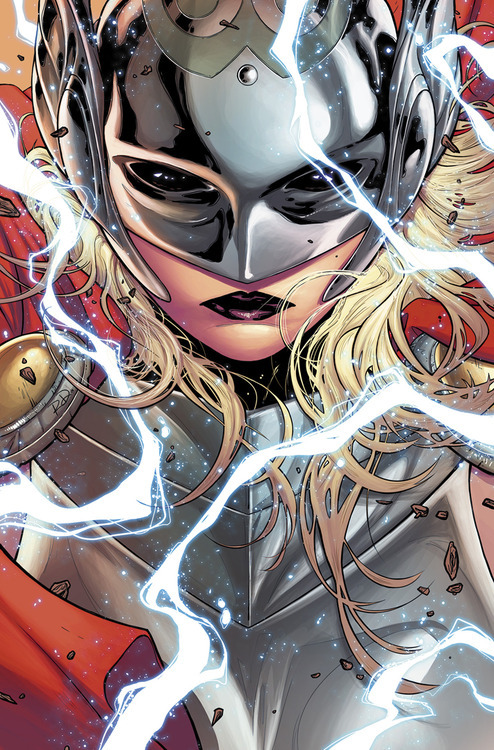
Seven Quick Notes on Thor Being A Woman


For the record, I take no issue with Thor being a woman. I am, however, puzzled by the decision, and worried about its implications.

1. The last time Marvel did this was with Ghost Rider, when sales dropped and the book was in danger of being canceled. It did not help. In business, this is called the glass cliff. It's a kind of "last resort, pandering while thinking outside the box" sort of synergistic effort in which a business that's not doing well will promote someone they wouldn't normally give the job to, the hope being either 1) They turn the company around, and they get to look progressive in the process, or 2) The company fails, and they get the protection of being able to say, "We tried the woman, and the woman didn't work out. Oh, well... Que Sera Sera." Speaking of intentions...

2. This is where matters get really touchy, so let the record show this a very broad generalization with a lot of assumptions which are most likely wrong. When a fictional character typically portrayed as white and male gets a race or gender swap, there's an issue of "why/why not?" that inevitably comes up.If the decision to make Thor a woman is "Because we can, so there!" Then it's arbitrary and therefore token, a stunt (see point 1). If, however, there's meant to be a greater significance to Thor being a woman, a comment on gender roles or a criticism of women in western mythology, then the risk is that the message overshadows the medium, Thor the character being traded in for Thor the statement. Granted, there's nothing wrong with that, Wonder Woman is a similar kind of statement, but she's also an interesting and compelling character in spite of the socio-political connotations attached to her. Similarly, when it came to Loki...

3. When Loki became a woman, it was in Lady Sif's likeness (she'd been killed in a recent story arc) to taunt Thor and play on his feelings of guilt. In other words, there was an in-narrative reason for the change that was in line with the original character, not merely a swap for swap's sake. Speaking of Lady Sif...

4. The comic Thor actually has a surprisingly good batting average when it comes to gender representation. There's Lady Sif, Amora the enchantress, Hela of the underworld (Loki's daughter), Brunnhilde and her Valkyrior troops, to name a few. Really, it's not like Thor was hurting for female characters, apart from a touch more variety outside of a love interest for The God of Thunder.

5. The idea of someone else being able to wield Mjolnir (by essentially the law of averages) was already explored with Beta Ray Bill, which makes the passing of the hammer seem all the more token. Thor doesn't work nearly as well as a legacy hero compared to, say, Green Lantern or The Phantom or even Batman (Knightfall, Beyond, Incorporated...).

6. What exactly will this mean for the films? It wouldn't be surprising if Tom Hiddleston passed on the role to Jaimie Alexander since there's a precedent for it in the comic. However, while we don't know the context for this change in the comics as of the time of this writing, Chris Hemsworth's commitment to his role plus the task of finding someone to take up the role in his place (given what a hard time it's been to bring Wonder Woman to modern audiences), it would make more sense for Marvel/Disney to leave the comic to its own devices and maybe consider following suit if the movies were to show a drop in box office returns. Given how the films have fared thus far, that sort of change would be years away even in the worst case scenario.

7. Does all this have anyone else thinking of the Silicon Knights' game Too Human, or is that just me?

As I've said, it doesn't bother me in the least that Marvel wants to make Thor a woman. It's piqued my curiosity, and I think it could be pretty cool. I simply wonder piquing interest and looking cool is all that's gone into the mission statement behind this venture. If so, that will be sad, so here's hoping I'm wrong.

10 November 2013

It's a Cereal!


I remember reading the first chapter of this comic in Nintendo Power back in the day. They'd more or less retired Howard & Nester, not to mention by this time I was firmly in Camp SEGA, so Mario & pals were essentially non-factors in my growth as a gamer by then. So, I didn't even know there was so much past that first chapter (thinking that this was simply a teaser for the game, much like a Sonic the Hedgehog comic/ad wedged into an issue of Disney Adventures was), let alone that it would actually be so entertaining and well-made. 

Even if I wasn't really into Nintendo then, I still appreciated the sense of raw, kinetic energy in the comic. I've tried in some of my own work to convey that same sense of, "FEEL THE URGENCY! GRAVITAS! DRAMA!" albeit to little if no avail, though I shall keep trying. 

15 September 2013

Tactile Response Controls

This happens entirely too often. In my defense, it's off-center because some lamebrains think laptops need built-in number pads on their keyboards. Who the heck needs to do 10-key entry on a laptop? 

04 September 2013

This Is Not Sharing

Based on recent events on DeviantART. 
Look, whatever side of the copyright/piracy/sharing issue you're on, no one respects a plagiarist, especially when that plagiarist defends their actions when confronted by the original artists. 

05 February 2013

KNOWS BOTH PEACE AND PAIN


Meant as an establishing shot for the previous comic, this ended up getting not only its own piece, but a second panel. In fact, these were going to be two separate images, but they really work best as a graphic match. Very fun to make, lots of micro-managing different layers and transparencies. Got into a groove and put the whole thing together in a day, with about a previous day of off-and-on sketching ideas and concepts, most of which didn't work out.

03 February 2013

THAT WHICH NEVER LIVED


The first, and very small, chapter to a much longer work I've been hacking away at the past few weeks. It's very prototypical right now, and this is meant to work as a fairly standalone piece anyway, so don't hold your breath. Even if the next part is a "sequel" it'll focus on the forces (right now I'm sticking with the name Guardians--not the owls or the holidays, not half as cool, anyway) that brought this megalithic watchtower down and gave it the resolve to rise from the ashes to kick technophobic ass.

26 January 2013

Let That Donut Be On Your Head


My little nod to The Spoony One:
In doing research for tabletop games, I came upon Noah Antwiler's episode of Counter Monkey discussing the logistics of confronting The Lady of Pain. In explaining exactly what Planescape is, how it works (or doesn't work, depending on your understanding of physics), and why one should fear the aforementioned lady, he analogized the City of Doors (Sigil) as a donut atop an asymptote overlooking a giant pizza. Well, I'd been making pizzas left and right the past few weeks (the one pictured's toppings include green olives and golden tomatoes, if you're curious), so I picked up a box of cake donuts, and started snapping. The comic panels came a bit later, as I was working on my writing project at the time, but the story was more or less always there.

The maze was a pain, but still really fun to draw, even if it completely ignores many of the basics of perspective. On the other hand, I was really, really unhappy with how my Lady of Pain turned out. There's a reason I don't draw people, even people with masks; the proportions never look right to me, and it's really hard to make a feminine face without resorting to full, pouty lips or simply drawing the face in profile. Anyway, the other character is a stick figure, so let it be known I'll always play to my strengths whenever I can, for better or for worse.

15 April 2012

Qomics Quintology Part II: Swords of the Swashbucklers number 2


This has left me feeling just a little bit morose. My attempt to make quality video projects using only what I've got at my disposal (and a little less) hasn't really yielded the results I'd like. Still, I intend to finish what I started, and I can say that because I actually finished part 3 before I started part 2 (even shot an introduction for part 4).

05 September 2010

Yeah, but it's the WAY you said it... (from Gamespot)

Magic Knight Rayearth for Sega Saturn

Here's where, despite not actually doing this for any sort of living, I betray my own sense of professionalism by not doing proper research before discussing a topic. During perusals of Hulu's fine selection of animation, I happened upon Magic Knight Rayearth, at one point one of the most difficult anime series to find on either disc or tape, almost as rare and hard to find as the Saturn game. In fact, the only consistently available iteration of the property is in the various printings of the original manga. I absolutely adore the manga, and even have the original Viz prints before Americanized versions of manga went to the original Japanese formats, leaving the books "unflipped" in smaller sizes and printed on cheaper paper.

For the record, I hate the change.

Granted, the publishers' reasons for doing this are understandable. At least, I understand that they wanted to preserve the original page orientations (with the spine of the book on the right-hand side instead of the left), but the smaller format and distinctly inferior (as in, one step above newsprint) paper just rub me the wrong way. Sure, these printing methods allow a volume to be sold at around 10USD instead of the typical 15 or even 18, but at least I felt like I got what I was paying for. Where once I thought 13USD for each volume of Rayearth was a good deal, I now find 10 overpriced. It's one thing for a monthly comic to be printed on cheap paper, since eventually the respective story arcs would be compiled into trade paperbacks, but with manga, the volumes are essentially the final product.

Anyway, here's the aforementioned betrayal: I know the anime series ultimately came ex post facto, but as for the relationship between the manga and the Saturn game, I'm just going to chalk it up to probably being one of those weird, circular relationships like 2001: A Space Odyssey's book and film counterparts. There's probably a Wikipedia page on it, or at least an article somewhere, but I just don't feel like looking it up to confirm chicken/egg conundrum that is Magic Knight Rayearth. In any case, I'll let someone else fill in that little missing piece of information.

As for the anime, I'd forgotten a pet peeve of mine until I started watching. On the whole, between dubs and subs, I had no real preference. In the VHS days, I generally bought dubs because video cassettes didn't technically give you the option to turn off the subtitles, so you always had irritating text genlocked onto the screen. There was also that paradoxical price hike that never made sense to anybody, wherein subtitled versions of anime series were generally about 10USD higher than dubs, despite dubs obviously being more expensive to produce. I'm sure the sales figures justified the difference, but it was still wildly unfair to those who preferred the subtitles; why not make them the same price? Fortunately, DVD seems to have completely nullified the argument, if only on the economic level. Still, there is a situation in which I would genuinely prefer to watch an anime series subtitled, and that's if I'd read the manga first.

This goes all the way back to when, even as a little kid, I dreaded the thought of there ever possibly being an animated version of Calvin & Hobbes. Don't get me wrong, I love Calvin & Hobbes; I still consider it the best newspaper-style comic strip series ever conceived. The problem is, I had my own idea of what Calvin sounded like (I never pegged down a consistent idea as to how Hobbes would sound; for some reason, Calvin just seemed more obvious to me.) and I knew that whoever would be selected to voice the little schizoid sociopath (let's face it, he was one, just look at the Transmogrifier story arc) would "get it wrong" and completely ruin my enjoyment of the comic. The same thing happened with Sonic the Hedgehog; I'd read a little promotional comic in Disney Adventures magazine prior to the game coming out, had my own idea of how the little blue blur sounded, and had that voice in my head (NOT in the schizophrenic sense, mind you) completely shattered when the animated series came out and Sonic was voiced by actor Jaleel White (Yes, THAT Jaleel White).

To be fair, I did warm up to White as well as the voice actor in Sonic Adventure for Dreamcast and all subsequent iterations following. Furthermore, when I think back to that voice I'd heard in my head reading the comic, it actually makes me laugh (Imagine one of the Chipmunks trying to do a Michael Ironside impression, and you'll have a vague idea of what popped into my head all those years ago). With anime, however, it's different, especially since the voice acting business is so small that many actors and actresses so frequently re-appear, typically voicing several characters. It was one thing when Urkel lent his voice to the world's most famous hedgehog; Like Luke Skywalker voicing the Joker, there's enough of a difference in how the actor approaches the character you more often than not don't recognize the voice (I wish I had a camera for some of the times I've told people that Mark Hamill has spent over 10 years playing the Clown Prince of Crime to capture the looks on their faces). When I recognize the voice actor (and if it's "off the mark" on how I think the character would sound), it's jarringly distracting and takes me right out of the experience. At that point, without the immersion and enjoyment, I'm left with critique and analysis of the character (I guess it's me trying to justify or otherwise deduce the casting decision), which can lead to some pleasant surprises.

Something I find interesting with dubs, from a filmmaking standpoint, is how the dubbing can actually change the entire demeanor of a character. If a name were to be given to this phenom, my vote would go to The Madison Effect. Granted, this concept has been present in dubs from day one. In fact, it goes all the way back to the silent era, when silent films had narrators (called Benshi in Japan) who would often embellish or re-interpret the events on screen. Suddenly, a love triangle becomes an overbearing brother protecting his sister from a would-be suitor, a grudge between two gunslingers centers around impressing a woman instead of a past betrayal at a bank heist, and a coded message sought by spies the world over goes from being a geographical record of missile silos to being a recipe for an egg salad sandwich (on a related note, when I first talked about Benshi for a Japanese class, my professor mentioned What's Up, Tiger Lily?, so maybe Tiger Lily Effect is more appropriate?). You get the idea. Anyway, the reason for the name Madison Effect refers to the American localization of CLAMP's own Cardcaptor Sakura (apt since we're talking about Rayearth), specifically the character of Tomoyo, renamed Madison in the English version. In the course of the show, Sakura's efforts to recapture the creatures of the mysterious book The Clow are recorded on video by Tomoyo, who even goes to the trouble of providing stylish outfits for Sakura to wear during her escapades. While this gimmick is consistent between the two versions, the motivations behind it are not. In the US version, Madison is portrayed as opportunistic and self-confident to a fault easily mistakable for callous, even, with her interest firmly rooted in the spectacle of rampaging monsters being defeated and subsequently tamed. In the original version, Tomoyo is practically a polar opposite, shy and soft-spoken, and somewhat creepily-loyal to her friend Sakura, whose costuming and video sessions were a staple of their relationship long before any of the magical creature hunting went down. Call it cynicism about Conservative America, but while this change in the character probably had to do more with cultural differences and attitudes about feminism (borderline Tomboy vs. obvious Wilting Lily) than anything else, it seems more likely the change was motivated by the simple fact that the original portrayal of Tomoyo was just downright creepy.

In the end, I don't think I'll be watching the rest of the series. I can't get past the dub, and the overall presentation, look, and feel of the show simply falls short of the energy and craftsmanship of the manga. Instead, I'm going to turn by attention toward Hulu's presentation of The Mysterious Cities of Gold, a show I have literally not seen in over 15 years.