21 February 2022
Kayaks and Counselors: An Ad Review
24 August 2020
Unhinged: The Batman Movie Nobody Wanted
Full Disclosure: I don't hate Uwe Boll. I legitimately admire his business sense. I also like In The Name of the King and Rampage. I'm going to lambaste the shit out of him here, but let the record show it doesn't come from a place of contempt, only brutally honest criticism.
It's not easy being Russell Crowe. I should probably have another disclosure about him, how the controversies about his personality, his run-ins with the law, have been painfully blown out of proportion. He's a walking example of the "But ya shag one sheep!" joke. Tom Cruise at least has Top Gun and the Mission Impossible franchise to balance out his... more eccentric attributes. Crowe's filmography has been almost experimental for the most part, as if directors and producers don't quite know what to do with him. His early career tried to play him up as a suave, smooth-talking charmer or relatable everyman/hearthrob (A Beautiful Mind, LA Confidential). He seems most at home in action (Gladiator, Robin Hood), but he's also tackled very cerebral dramas (Master & Commander, Cinderella Man). Then, there's Noah and Man of Steel. Jury's out on those. I mean, I like them, and he's the best part of the latter.
His films are few and far between compared to most auteur A-listers, which unfortunately means every new entry is a tough sell against the deluge of controversy. When the trailer for Unhinged was released, there was no shortage of wannabe jokers in the comments calling the film a cinema verite style documentary about Crowe's daily life. I want to give him the benefit of the doubt that this is him effectively owning the controversy, some para-meta-ironic middle finger to his haters, but he's either too late to the party to pull the prank on the pretentious preppies, or he's killed the man and become the monster.
I'm calling this an unofficial entry/preview in a series of posts I've got in the pipeline entitled, "Reasons I Shouldn't Write Screenplays" an idea I freely admit to stealing whole cloth from Noah "The Spoony One" Antwiler. They're as much musings and meditations on various tropes and trends of the Hollywood dream factory as they are semi-serious sales pitches for reboots, reimaginings, retoolings, or redirects of some of the biggest franchises and flops dotting the greater pop culture landscape.
The plot of Unhinged takes it cue from horror writing 101. Take a mundane, inconsequential thing, and turn it into a matter of life and death. This isn't a bad thing, only a little tired. No movie is ever released in a vacuum and some of the dialogue is not helping to convince people of idea parallelism (a fancy legalese-esque word for a coincidence).
A single mother (Caren Pistorious) is driving home with her son when she gets stuck behind a pickup truck at a green light. In a fit of frustration, she emphatically honks her horn before giving up and driving around. The owner of the truck (Crowe) later confronts her that a brief tap of the horn would have been sufficient while explaining that he's been having a bad day, apologizing for earlier while expecting the same from her. She stubbornly dismisses him, and the conflict ensues. At one point on the driver's path of systematic destruction in the name of revenge, he reveals his intention is to show her what a bad day really looks like.
That line struck more than a few familiar chords with film-goers, with many mentions of the Alan Moore story The Killing Joke going hand-in-hand with the comparisons to the recent Oscar nominee Joker, starring Joaquin Phoenix. The Killing Joke was written in 1988 hot on the heels of Frank Miller's Dark Knight Returns series in an effort to convince the wider public that the caped crusader was not the bright and colorful shark-repelling deputy cemented into the public perception by the Adam West-led TV series. It attempts to offer an origin story for the Joker, one that's meant to paint him as a tragic figure, a victim of circumstance. As part of his plot to garner sympathy for his situation, he opines that anyone could have become the Clown Prince of Crime as a result of "just one bad day."
Hollywood has toyed with this idea in the past, examples including the likes of Taxi Driver, The King of Comedy, Straw Dogs, and Falling Down (to name a few). Those movies predate the Columbine disaster by many years, and while mass shootings and other acts of terror by disgruntled individuals have a history predating those films (Dog Day Afternoon being loosely based on a real life event), an apparent increase in violent shootings and assaults have brought this trope under a new light of scrutiny. Much of the scrutiny feels misdirected, like it's working under a false premise that the main character of any movie is meant to be perceived as a heroic ideologue. It's true many misunderstanding movie-goers (mainly male) may make a manifesto of the malignancy and malice, missing the masqueraded meaning regarding motives, means, and opportunities. That is, these characters are only heroes by default, the lessers to greater evils. The circumstances that created them and drove them to their extremes are not triumphs, but tragedies not unlike those that befall the men who slay monsters only to become them in the process. The modus operandi of these misunderstood ordinaries are not meant to be mimicked outright, but mulled over.
To put this process in perspective, Roger Ebert described the comedic machinations of the Naked Gun movies thusly: You'll laugh, then laugh at yourself for laughing. You may well find yourself rooting for Michael Douglas as he obliterates a phone booth with machine gun fire to spite an impatient man eager to make a call. It's easy to find yourself dancing to Joaquin Phoenix's beat as you traverse any long sequence of steps. None of these reactions are inherently wrong. That's the magic of movies, if not the whole of storytelling in general.
I made an off-hand comment to a friend on Twitter about how Unhinged was essentially what we'd get if Uwe Boll adapted The Killing Joke but ran out of money and/or lost the rights to the Batman license partway through. Obviously, the film in no way, shape, or form resembles The Killing Joke beyond some throwaway lines that touch on the same philosophies about human nature, the choices we make, and our responsibility in light of the consequences of those choices. That said, the more I thought about it, the more I realized this plot has a stronger tie to the Batman universe than likely anyone involved in the film realizes.
Put simply, the Joker is no stranger to road rage.
Joker's Favor is an early, but much-loved episode of Batman: The Animated Series. While typically falling shy of any top spots, it often ranks highly on many best episodes list, and it's not undeserved. It also takes a mundane, inconsequential event and turns it into something far more sinister. An accountant named Charlie (voiced by Ed Begley Jr.) drives home from a bad day at work. His impatience with other drivers ends up getting him face to face with the Joker. Joker lets Charlie go on the condition that he may well ask him for a favor some day. Two years elapse before Charlie, despite having moved and changed his name, is contacted by the Joker to fulfill his end of the bargain from earlier.
What follows is a rather predictable turning of the tables in the cat and mouse game via an ordinary man being driven to extraordinary actions, though with the saving grace of a timely and graceful step back from the edge. What makes it work is the show's complete and utter commitment to the subject matter. It's played perfectly straight and allows you to suspend disbelief on how things will turn out for those involved.
Unhinged, just like Charlie's future in Joker's Favor, could go a number of ways. Monsters can be slain as easily as they can be made. Currently, its box office performance (including a delayed release thanks to the Coronavirus Pandemic) is less than impressive, a few million shy of halfway to its 33 million dollar budget (Falling Down was made for 25 million in 1997, a little over 40 million adjusted for inflation). Critics have been equally cold, dismissing it as uninspired, unable to justify its own existence against other films of its stated variety. Those jokes about Crowe's temper seem to have run their course. As for those other comments calling Caren Pistorious' character a Karen...
02 April 2019
Jumbo Shrimp
It's not bad, but it's borderline forgettable and hollow. I'm hard-pressed to recall an instance of seeing a weaker story told with less conviction. All the ingredients are there. We're introduced to this big cast of colorful characters, and the half that aren't lost on how to play their parts only get maybe 5 full minutes of characterization out of the entire runtime. So, when our merry band of misfits all rally together to save the day, all I can think is, "and you guys are...?"
The art direction is rock solid and the score is beautiful, but the story bites off more than it can chew in an attempt to pad out the plot of the original, which has now been reduced to a 20-minute abridgment serving as the opening act. The rest is equally hurried and scattered, as though bored with its own concept which at times feels borrowed from other movies. The pink elephants do make an appearance, but I doubt it will be long before we seen side-by-side screencaps of it and the opera scene from Revenge of the Sith.
Of all the forthcoming live-action/realistic CG versions of Disney classics coming out this year, this was the one I was most looking forward to because it seemed like it was going to offer more than a scene-by-scene reenactment of the source material. Technically, I got what I wanted, using the original premise as a jumping-off point to tell a bigger story. Unfortunately, that bigger story is so thinly-spread and half-hearted in execution even the finale feels like padding, all half-finished ideas and tired platitudes.
Full disclosure: "Baby Mine" still makes me cry.
17 March 2019
Coffee Got Scooped
17 March 2018
A Wrinkle in Time
Only two things truly bug me about this movie, one's a nitpick that's in no way a dealbreaker, and the other's more of a question. Firstly, Aunt Beast is mentioned once and seen for all of 3 seconds. It's a somewhat creative look, but easily the weakest piece of art direction in the film. The stage play had furry starfish the actors could shift around inside to operate different limbs, emphasizing their non-humanoid form. Here, we have mammoths with spider-legs, seen way off in the distance... in a haze... before swiftly moving on to the next scene. Like I said, not a dealbreaker, and if the Ixchell had simply been omitted, I wouldn't have even cared. Speaking of omissions, notably absent are the twins. The Murry family is only Meg and Charles-Wallace. Granted, they didn't have a big role in the book, but they were important later in Many Waters. What I'm wondering now is if Disney is going to go ahead and make the other Time Quartet books (Quintet? An Acceptable Time is canon...ish? I'm spoiled on numbered spines, what's wrong with me?) are they just going to have the current collection of kids carry on and rewrite the plot to them, or are they somehow going to find a way to introduce the twins later, maybe as visiting cousins? The Time Quartet In Five Parts (?) was essentially Young Adult fiction before the great Hunger-Potter Explosion, when publishers didn't market these much outside of school book fairs, and the authors tended to play pretty fast and loose with overarching structures and deadlines. My point is the cynic in me fully expects Disney to try and do for the Time Quintaret as a franchise, but it doesn't look like they're taking any steps to do that, and while part of me is okay with that, it's a very odd strategy for The House Walt Built between Marvel and Star Wars. It's like I want more but I'm afraid to ask, if that makes sense.
25 February 2018
Annihilation
Arrival dealt with issues of communication, language, philosophy, and cultural bias to tell a reality-bending yarn about cause and effect. Annihilation tackles issues of identity by exploring a somewhat obscure region of the uncanny valley. I mentioned Solaris, in which an alien consciousness tries to answer the messages its picking up from a space station by creating these "approximations" or "estimates" of what it thinks would be good answers to these questions, often with unintentionally violent results. Annihilation looks at the same dynamic through what amounts to full-fledged body horror. Most of the time, it's subtle, even artful in places. Other times, the existential terror of questioning what we do or don't consider familiar gives way to an outright shock and awe gorefest. These scenes are few and far between, with only one that had me looking away from the screen, but they overall felt hollow and superficial, even juvenile on some levels. I'm no prude, mind, but with the way these scenes were framed by the rest, I have all suspicions that this movie could have gotten away with a solid PG-13 rating than trying to reach for R by the skin of its teeth and reaching for the low-hanging fruit of sensationalism.
For the purposes of review, this is overall my strongest criticism, and I'll never pretend it's at all elevated above nitpicking. I only bring it up because it did so well to make my skin crawl that when it changed gears to merely making me sick to my stomach, I felt insulted on what I can only describe as an intellectually masochistic level (I'M HERE TO LOSE MY MIND, NOT MY LUNCH, DAMMIT!).
If I had to stretch for a bigger issue with the film, it's got more to do with the aforementioned sub-genre serving as the source than anything that unfolds on screen, and that's the characterization. I've found with the more cerebral sci-fi is that their writers are definitely more deeply in love with their plots than their players. Arthur C. Clarke suffers from this immensely. As much as I love 2001 and Childhood's End for their unforgettable plots, his characters are barely memorable, borderline inconsequential (which you could argue is part of the point, challenging our inflated sense of significance and all that), or even tacky in places. The cast is all fine, it's their characters who are a bit flat and one-note. I suppose it's to help make them easier to project onto or identify with or at least not overshadow or distract from the plot, but I feel like this prioritizing of events over individuals works better for a novel than a movie, since the craft of acting itself is meant to engage your empathy rather than your intellect (it is, after all, the oldest special effect). What even calls this relationship of players and plots into sharp question is when those occasional spots of pure carnage for carnage's sake turns our "audience avatars" into cannon fodder. Annihilation gives you so little to invest in when it comes to characters that when it takes them away, you wonder why it bothered. It makes what should have been a big reveal or harrowing conflict or moral dilemma lose just enough impact to feel like a missed opportunity. You love it for challenging you, and hate it when it pulls punches.
To its credit, there's more hard knocks than soft blows. There are times when the movie is frighteningly beautiful. Last Jedi and Black Panther celebrated color, Annihilation makes it something to fear. Most movies overuse lens flare, Annihilation makes it matter. That's brilliant.
17 February 2018
Black Panther
birds lay eggs,
and Marvel movies are good whenever they're not great.
(tosses napkin on the plate and excuses self from the table)
I swear I'm not trying to be a grouch about this, and none of my critiques are meant to put the movie down. This is one of the better ones, maybe not Thor or the 1st and 3rd Captain America movies, but definitely better than Iron Man 2, possibly the only Marvel movie I actively dislike (if only because I haven't seen The Incredible Hulk, which is only because I can't stand Edward Norton). As for Panther, the extent of my knowledge of the character begins and ends with a miniseries written by Reginald Hudlin and artwork by John Romita Jr., and as far as that goes they nailed the character and lore, delivering on all my expectations. I'm glad they kept the outside references to the other films at a minimum save some cameos and flashbacks, keeping it self-contained (like Doctor Strange) while firmly nested in the overall timeline. I'm certainly glad it didn't pull an Iron Man 2 and grind its own plot to a screeching halt to tell me how great Infinity War is going to be. On the whole, my only true criticism of the film is that while it's self-contained in terms of story, it is all still a bit familiar, and beyond some awesome art direction (What The Last Jedi did for red, Black Panther does for purple), there's not a lot it brings to the table we haven't seen before. There's a little Cap here in the car chases, a little Stark there in the gadgetry department, and a dusting of Thor (or even Guardians) for some of the battle scenes. Again, this isn't bad, but I think sometime after the end of Iron Man 3 and just before the halfway mark of Guardians 2, I may have hit my point of saturation. We had no idea what to expect from Thor or Captain America, certainly not their second installments, and those pre-Disney Marvel adaptations like Daredevil or Ang Lee's Hulk had their issues, but at least their flaws were interesting, even experimental on some levels. Now, we've clearly found a rhythm and a rhyme you can marry to any melody and it won't not produce a chart-climber. I hate saying that given how close to the brink of death the superhero genre has been from time to time, but on the whole the nicest thing I can say about this movie is that if you've loved all the past Marvel films, this one won't disappoint, but if you're maybe growing a little tired of filling out the MCU Bingo card, this isn't going to shake up the game.
Then again, as I've implied, I am one of those weirdos who likes Eric Bana's Hulk and Ben Affleck's Daredevil, so don't let my damning with faint praise deter you from giving it a shot.
30 July 2017
Ghost Trick: Phantom Detective (First Impressions)
As a compromise, I limit one game per device, a maximum of one microtransaction if the game is free-to-play, and with very strict rules on genre, namely no puzzle games like Bejeweled (I still haven't forgiven my Dad for getting me hooked on it) or endless runners like Jetpack Joyride (my Dad still hasn't forgiven me for getting him hooked on it). Ghost Trick: Phantom Detective from Capcom, which at first I thought was a spin-off title in the Phoenix Wright series*, is almost a puzzle game. It's a point-and-click (tap-and-hold?) adventure game with logic and time-based puzzles.
| Hmm, that "D" looks familiar.... |
| Like that there parrot that done ceased to be... |
Manipulating possessed objects forms another third of your suite of phantom powers, called "Trick" mode for the sake of a title drop. Although the backgrounds have the same degree of awkward clutter as a hidden object game, the number and type of objects you can inhabit is limited, complete with a few red herrings thrown in. If Ghost mode reminded me of Firefly's Diary, this part of the game reminds me of Haunting with Polterguy on the Genesis. In that game, your goal was to scare away the inhabitants of a house. Your tricks here are a little more versatile and subtle, though getting attention via diversion and distraction is a core part of the gameplay. This part can become the most frustrating as many of the tricks you have to pull off rely on characters standing in specific spots, looking a certain direction, or performing some subtle action you're likely to miss more often than not. It always strikes me as a cheap tactic to reduce strategizing and problem solving to a time trial in order to make something more challenging.
| A Dead Dog, a Distressed Damsel, and a Dastardly... Dog-killer? Yeah, let's go with that. |
| The way the big guy slaps that command console always kills me. |
As of the time of this writing, Ghost Trick is available in its entirety for 10USD, and I can't decide if that's too much for a mobile game. I honestly don't know how much I've ever spent on a phone game, maybe 6 or 7 way back in the day for the Wolfenstein RPG, and frankly that may have been too much. Then again, I've easily spent over 40USD on all the various drawing programs across all my mobile devices. Of course, there's simply no comparing the value of a productivity app to that of a game, however addicting and fun said game may be.
| Does this count as interest? |
Suspect pricing structure aside, I enjoyed the first two chapters of Ghost Trick, and while I ultimately intend to unlock the full game, it's an odd duck even in the mobile games market and I don't recommend diving in without testing the waters first. Fans of "match three" puzzles and manic tapping may be turned away by the pacing, while fans of deeper experiences like "escape the room" or remastered ports of older games may find the total package somewhat shallow. The last comparison I would make is to Jordan Mechner's The Last Express. It's a technically ambitious work of art whose only real fault is simply not having more of itself to offer. That can leave a lot of gamers grumbling, but I'm of the mindset that if a game ends too soon, it was probably just long enough.
*Ghost Trick was produced by the creator of Phoenix Wright, and once speculated on a crossover game, but the title sadly remains a one-off.
18 June 2017
Four Movies
28 February 2015
Auvio Headphone Amplifier Review
I like to think I've got pretty good hearing. I don't regularly attend concerts or trade shows, and before I got moved to a quieter building at work, earplugs were my best friends. As such, I've never quite understood headphone amplifiers. I'd heard of them, of course, but only in terms of gear for video and stage crews, people who need that extra boost to hear directors and stage managers over the crowds, pyrotechnics, and walls of Marshalls. As for everyone else, it seemed a bit pointless. Even then, what ones I saw for consumers were specifically marketed as assistive listening devices--hearing aids for people in denial.
A few years ago, a revelation into the sheer scope of headphone amps available came to me when a game designer I follow posted an image of the FiiO E09K dock into which was inserted an E17. At first, I couldn't even figure out what the damn thing was (I thought the E17 was an mp3 player), literally researching and double-checking my research utterly convinced I was missing something. There was simply no way something could cost that much that was little more than an upgrade to a volume knob. Even considering the existence of bling culture, the handbag industry, and lowriders, it seemed an asurdity.
I mean, if you had that kind of dough to spend on an amp for headphones, wouldn't it be more prudent to simply buy better headphones? It made me think of that ad for Rhino TuffGrip that showed the signature spray-on spackle applied to a Chevy SSR bed, irreparably coating the hand-polished wood runners.
It turned out even FiiO thinks their stuff is overkill, and most of their product photos show the amps hooked up to earbuds and strapped to the backs of smartphones.
That's when I kind of got it.
Remember how expensive the Macbook Air was yet had one of the worst onboard cameras ever made? That's really where FiiO's bread and butter seems to be; lending better audio to devices that skipped out on it despite higher price tags. Granted, that still makes it an impossibly niche market, but no longer a complete absurdity.
Moreover, I learned that the amps don't merely raise the volume, but actually enhance the sound by picking up the slack for the built-in amps of the device they're connected to. I was skeptical of this, as audiophiles tend to be the homeopathic, free energy flat-earthers of the tech world. There's also the fact that a headphone amp doesn't bypass the internal amp of the device, although I'm sure a sound engineer could fill me in on what I may be missing in this equation.
Recently, I went to Radio Shack to exploit their financial failings by way of their everyhing-must-go sale and picked up, among other things, a tiny headphone amplifier. In fact, I got two in case I wanted to take one apart. It's from a company called Auvio, whom I'd never heard of before and suspect they may well have been exclusive to Radio Shack. I won't tell you how much the markdown was, but the initial retail price was around 30USD, very close to the now-discontinued FiiO E6. It's about the size of a matchbook with a nice, rubbery finish and capped off with a brittle-feeling clip that I don't trust one bit. Despite its size and notable lack of heft, it's surprising the level of pure tech under that tiny hood.
Going back to what I was saying about enhancing the audio, it's true that most lower-end headphone amps are simply volume boosters, but some have equalizers built into them. These isolate certain frequencies and bring them to the forefront, namely bass and treble. The trouble with most audio players (specifically devices for which music player is an afterthought) is that the internal amplifier circuits aren't well-made, effectively homogenizing the deep bass and high treble sounds, robbing them of their respective nuances.
The Auvio's EQ has three settings apart from "OFF" which are indicated by a slick little LED just under the top of the clip and toggled using the power switch. Blue boosts both bass and treble by 5dB, Red boosts bass by 10dB, and pink boosts treble by 5 and bass by 10. It doesn't sound like that much variety (where's the setting that boosts treble alone for, say, spoken word or talk radio?), but the effect on my PSP was surprisingly remarkable.
For this test, I used three different headphones, all Sony (shameless fanboy here) and all over-the-ear: a low-end mdr-zx300 with a lovely metallic red finish, a mid-range noise-cancelling pair (mdr-zx110nc) and the gold wireless headset for Playstation. The noise-cancellers are my personal favorite, but possibly a bit of overkill with the amp. The mdr-zx300s, on the other hand, sounded great. My testbed, apart from some Pink Floyd, was Falcom's magnificent Ys series, namely Seven and Oath In Felghana. Followers of the flame-headed Adol Christin are likely nodding their heads right now; few franchises have such consistently awesome soundtracks, perfect for testing sound gear. Although none of the settings were really a good fit for either game, they did help give those power rock tracks that added "oomph". The effect was a bit lost on the wireless headset, but that's more a matter of ergonomics than quality. They're not exactly made with the PSP or even the Vita in mind. I can't speak to the volume boost feature, except to say I had it about as low as possible, and it still sounded great.
Does the amp make the PSP sound better? Yes, but I don't think it's enough to recommend seeking one out. Having the ability to EQ the output was a nice touch, leagues above the presets, but that doesn't make them worth the price tag, even at the marked down price. As I said, it's better to simply get higher quality headphones, ones that emphasize bass boost. If you want the absolute best sound out of your PSP games, the best option is to play them through a VitaTV and use your home sound system. Obviously, that option's only for you if you don't care about portability and your game was a download rather than on a UMD.
In the end, the experience of using a headphone amp is a highly subjective one, definitely not for everybody. The best advice if you're curious is to borrow one. If you only care about volume and not the depth or fidelity, then you may want to consider making one. The CMOY is a popular hobby project that uses an Altoids tin and a handful of components (no soldering required if you get some conductive glue).
02 October 2014
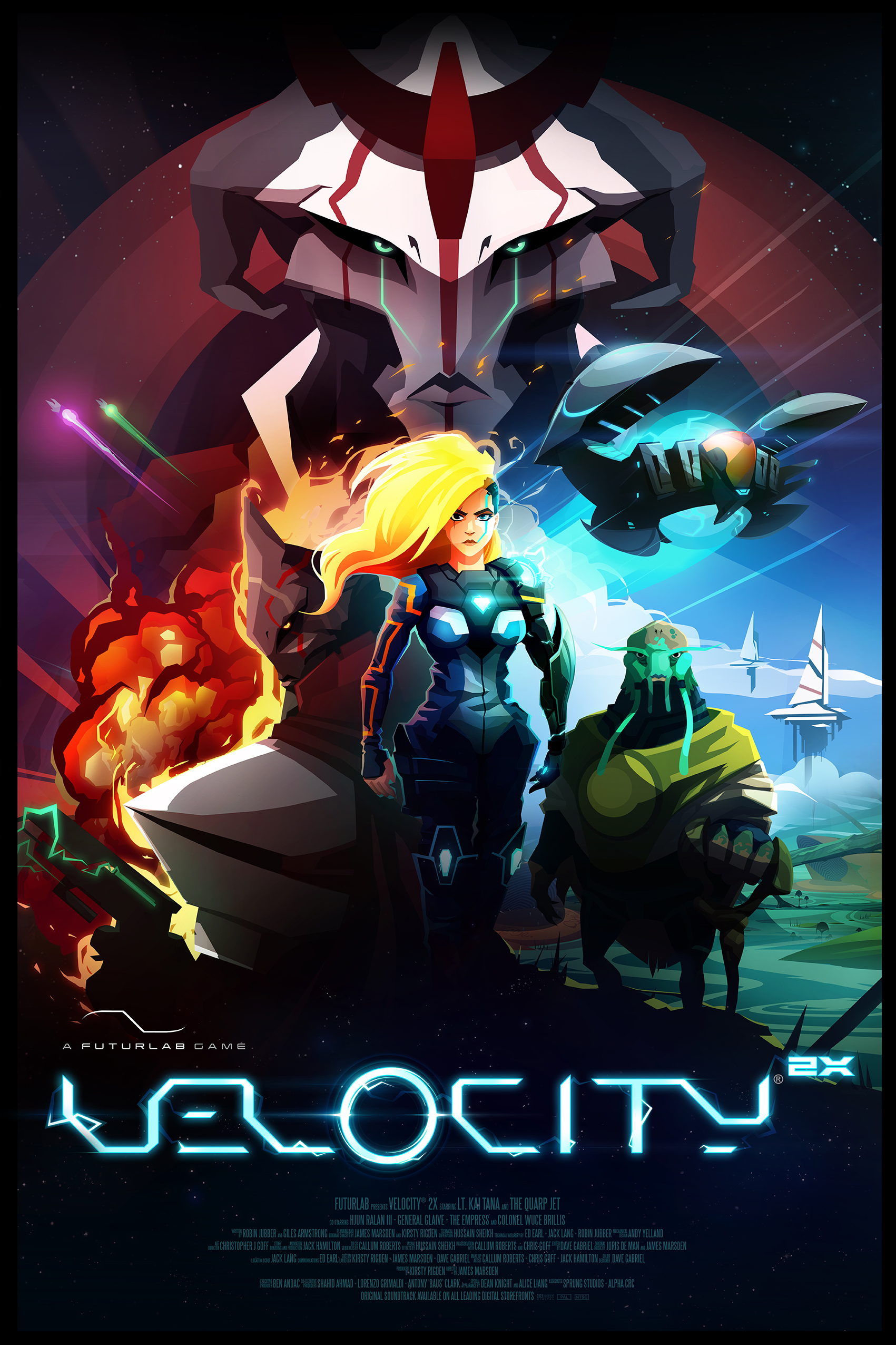
Velocity 2X Review (PSVita)
![]() |
| "Aw, Hell, yeah!" |
1. Everything is an improvement.
The first Velocity game had a straightforward, NES-era sensibility to it, reminiscent of games like Metal Storm or Contra. The art direction and level design was simple, some might even say bland or samey, and enemy variety was a tad underwhelming, but it was cohesive and solid, everything fitting together perfectly. On top of that, it had very tight controls and unparalleled gameplay. It was almost perfect, hardly feeling like a Playstation mini.
Velocity 2X might seem like it does very little to build on its predecessor, with many changes so subtle, they can be easily missed, and it's doubtful many will appreciate them. The artwork is still overall minimalistic with its textures and color palettes, but many levels have such fine details and subtle touches (like waterfalls that surprise you with a sense of height) that it's easy to get lost in the sheer beauty of certain spots.
2. Gunning and running.
When I first saw the screenshots of the "on foot" segments, I was a little bit worried. It seemed like the step the folks at FuturLab took off the ship was a timid, cautious one that played it safe and checked with its neighbor. Frankly, it looked like an endless runner. Don't get me wrong, that would have made sense, and I love many of those games like Jetpack Joyride and Canabalt, but it would have felt like a token gesture toward expanding on the original concept. Luckily, I was so very wrong and I couldn't be happier about it. It is, in fact, a fully-realized sidescrolling platforming shooter with puzzles and exploration. There's even some combat and physics thrown in for good measure. It reminded me of Major Havoc with a touch of Metroid, all with the slick polish of WayForward's Bloodrayne: Betrayal. Kai Tana has extremely fluid and graceful animations, whether it's leaping across a disintegration field or firing her palm blaster (which makes me think of Vanessa Z. Schneider from P.N.03, a stylistically similar title I also happen to love) or even waiting for an elevator.
3. That certain... I don't know what.
Actually, I do, but it's a little hard to describe. The short, crude version of it is: it makes you feel like a badass. Word is that the development team had to insist on a female lead even as far back as the first game, when we never left the ship. I, for one, am glad they stuck to their guns and delivered an awesome character who manages to be dead sexy, and does so on her own terms. When you're standing in a chamber of crystal deposits firing that hand cannon in a circle, shards of glass and debris falling all around you, it's hard not to let a smiling, "Aw, Hell yeah!" escape your lips. Before long, you're taking down Vokh patrols like it's second nature. You'll be flinging bombs at switches and turrets like you can see the future. You'll have distributing telepods down like a science. All, this, and you'll know it's you doing it, not some contextual action script set to Quick Time Events or button-mashing. That's a hard feeling to achieve, and this game nails it.
What doesn't work
1. The side scrolling stages have room for improvement.
It was often difficult to use the teledash while jumping or falling, and it would be nice if I could simply tap the screen rather than aiming exclusively with the controls. It would also be nice if your telepod inventory was separate from those you have for the Quarpjet (there's a notable size difference). I actually managed to just about break the game because I didn't realize I'd used up all my telepods back on the ship and got myself stuck. Of course, I could probably have backtracked to the ship, but since I didn't realize the inventory was shared, I thought it was a glitch. On that note, while the idea of the telepods to get through narrow hazards is great, it felt like I was having my hand held for far too long. At various points in the levels, there are these pads you're meant to stand on and aim your telepod at. I could understand these in the level wherein you're introduced to the mechanic, but having them throughout the game feels like there's no strategy to it.
2. Speaking of telepods...
While micromanagement of telepods is vastly improved, namely the fact that you can retrieve spent pods through the map screen, the "shortcut" of hopping over to the last pod dropped by double-tapping the triangle button is a surefire way to get innards smeared across a bulkhead. At least two out of three tries caused me to drop two more pods where I stood. That double tap has to be just perfect, and I could never do it on command. The sidescrolling stages didn't have this problem, which makes me wonder if this could possibly be a runtime issue.
3. Speed Pads Are Worthless.
Velocity is a thinking man's shooter. In a game that already invigorates its genre by favoring pre-planning and exploration over twitch reflexes, having parts that railroad the player onto a fast track feels tacky. What's the point to the thrill of the added speed if you've got to be that much more alert with your teleporting? It's not even as though they're placed in strategic locations that would give you the best of both worlds if you were quick thinking enough to hit each one in rapid succession. To be fair, toward the end, one mission had them placed so close to upcoming walls that I had to resort to the old control method of teleporting, which was admittedly a nice touch. Still, I'd rather speed pads have been part of the DLC or bonus missions.
4. Mission 42 became the bane of my existence and nearly led to a ragequit.
As great as touch controls are for teleporting across the map, it's not half as precise as it could be. I was convinced I'd found a bug because no amount of tapping could get me into a space after deactivating its force field. I restarted the level twice before I found out, practically on accident that the actual "'portable" area in the space is so small that even aiming the cursor with the analog stick felt like threading a needle on the roof of a speeding train.
But my absolute biggest gripe...
5. The calculator is not scientific.
I mean, come on, guys. You know the Vita can handle it. Hell, the PSP could have done it (though the lack of a touchscreen would make things a bit tricky). I'm not looking for graphing capabilities or currency conversion or reverse Polish notation, I just want to know the spirit of the great warrior shaman SoCaToah is watching over me wherever I take my Vita.
What I'd like to see next.
By favoring exploration, Velocity solves the problem of the Vita being widescreen. In typical SHMUPS, the gameplay favors verticality, with many arcade cabinets having their monitors mounted sideways. Velocity, meanwhile, started on the PSP, and therefore added a more pronounced X-axis to the movement repertoire. That said, I would love to see a version of Velocity that favors a vertical screen, namely a smartphone. Between Playstation Mobile and Playstation Now, I'd really love to see what Futurlab can do with more visual real estate.
Cooperative play may not be any sort of a game changer, but it may be a fun idea to explore. As a fan of The Last Starfighter (which, given some of your alien companion Ralan's lines, I think the developers are, too), it would be a great exercise in teamwork to relegate flying to one pilot with weapons and teleporting to a co-pilot.
01 June 2012
Frightened, but Brave
Just got back from Snow White and the Huntsman, and I'm not even going to make a comment about Mirror Mirror leaving bad taste in my mouth and this being the cleansing swig because it's an unfair comparison.
In short, loved it. Awesome. Highly recommended.
In the interest of full disclosure, let's address the elephant in the room: I have never seen the Twilight movies. Actually, that's a lie; I've seen five minutes of a scene with two groups of vampires comparing notes on feeding habits and it pretty much told me all I need to know about what I'd be in for if I stayed and watched the rest. I bring this up because my roommate has seen the Twilight films and as such her biggest hangup about seeing the film was Kristen Stewart, fearing a wooden performance.
I think she gets a bit of a bum rap. Granted, the only thing I've seen her in prior to this was Zathura, where she played the older sister of the two boys. Not much meat to the role, but I liked her in it.
Something most people will probably notice right away regarding performances, hers as well as others, is that dialogue is rather sparse, and given that Stewart has a fair amount of screen time in the first act, people might be led to believe that her part was toned back because of fear about her ability to deliver dialogue. This really isn't the case; overall, it's a very visual film with very long passages of silence. I think that's one of the film's greatest assets, not feeling like it has to hold the audience's hand or keep spouting little throwaway lines of expository dialogue. What little dialogue there actually is serves almost as padding. Seriously, this would make a dandy silent film.
At the risk of sounding like I'm gushing, and going back to what I was saying about Kristen's performance, I think she's one of the best female leads I've seen in a fantasy film. She's got a very rare quality that I first heard leveled at the late Elisabeth Sladen by former Doctor Who producer Barry Letts. He said of her:
"She could be frightened and brave at the same time. Most actresses can only do one or the other."
This is also how I felt about Naomi Watts in the Peter Jackson remake of King Kong, someone who has a confidence and inner strength, but is also a human being with a full emotional palette. On that note, I think my favorite scene in the film (stop reading if you don't want any spoilers) is one where she stares down a monstrous troll that's just made a rag doll of the Huntsman and sets its sights on her. Admittedly, it waxes incredibly silly, but it made me smile and, frankly, if I made a fantasy film, you bet I'd have a scene like this. It's Dorothy slapping the Cowardly Lion, but done better. It speaks to her character, saying, "Look, I'm cold, tired, and terrified, but damned if I'm going to run now!"
Sure, not a terribly deep review, more just first impressions, but it's a very good first impression. Again, highly recommend it.
21 April 2012
Qomics Quintology IV: What If? No. 83
We take a look at one of What If...?'s boldest and most experimental "alterniverses."
Something about my current editing process:
As I'm using Linux, my video editing options are somewhere between slim and nil. For a time, I used a program called OpenShot, which I was very impressed with to the point of calling it the Linux equivalent to iMovie or Windows Movie Maker. The trouble is that I went from using a small form-factor Linux computer that I built to a Dell Optiplex that some law firm my roommate's nephew worked for didn't want anymore. It ran Windows XP, but was locked with a password and had no recovery disk, which prompted me to just running Linux Mint on it. All seemed well and good, but somehow Openshot decided it didn't want to work anymore. The first time I used OpenShot, I got an error message telling me I needed some codecs so it could properly export the video. Luckily, all I had to do was enter the names of the codecs and the error message in a search and I got a solution right away. Later, when I got the Dell, I ran into a similar problem, but when I downloaded and installed the right components (and a few others) just like before, absolutely nothing happened. OpenShot just didn't want to work at all.
This meant I had to use YouTube's built-in video editor, which is serviceable but has two important problems. The first problem is that I basically have to upload all my raw footage, edit each clip individually (namely trimming), and then open a new project in YouTube's editor. This takes hours. One of the great advantages of recording to SD cards or an internal memory is that all I have to do is drag and drop the clips into the editor, which works almost instantly. With using YouTube's editor, it's akin to using tapes, where you have to sit and watch it download in real time. The second and most irritating problem is that, if I use multiple cameras, the video's overall resolution defaults to the lowest.
The Nokia Nuron, which could well be my favorite video camera ever, has the ability to shoot with colored filters, trim and merge clips, and even allow me to dub over the soundtrack. It's surprisingly robust for a feature that's essentially an afterthought on a phone. The catch is that not only is it not a high definition video, it's barely standard definition.
Without getting into a whole mathematical mess of aspect ratios and resolutions, the key point is that my Sony Cybershot shoots HD video, which means each frame is 720 pixels tall. A DVD, by comparison, is 480 pixels tall (that's standard definition). The Nuron's widescreen mode is 360 pixels tall. Since I'm recording the introductions to most of these videos on the Nuron, that means I'm asking YouTube's editor to merge a 720 image with a 360 image. In the end, the maximum resolution of the completed video project is only 360 pixels tall. No high definition, not even standard definition. It's still 120 lines more than a VHS tape, but it basically means I'm not getting the best image possible.
On the whole, though, while shooting in HD is appealing, I care far more about my videos being widescreen, so it's a small loss and really just irritates me because HD video eats memory card space.
In short, I really should just upgrade my system to something that can handle a more practical and versatile editing program such as Sony Vegas, but two things: 1) I can't afford that kind of upgrade (got a bit eaten alive on my taxes thanks to something from my past coming back to haunt me) and 2) In the end, I don't make videos all that often. It's only rarely that I get the bug to film something and it often goes as quickly as it arrives. About the only reason I put as much effort into it as I do is because apart from sales of my prints on DeviantART, my videos are one of the few things I produce that can generate money via ad revenue. Granted, it's not going to supplant my day job anytime soon, if ever at all, but it'd be nice for a few embellishments and frivolities, so anything that can help get me a return on my investment (even for a hobby) is worth pursuing.
17 April 2012
Qomics Quintology Part IIIb: Nadesico
I make a startling discovery about one of my favorite writers... and I'm driven to drink because of it.
Qomics Quintology III: Manga Formats
Probably a little more personal than previous installments, if only because I'm working with an existing collection instead of the one I'm building now.
14 April 2012
31 March 2012
Alesis Videotrack (Build Quality & Accessories)
Follow up to my Camera Complaint video, wherein I explain
the rather poor audio quality. Interestingly, it's not because
the microphones were of poor quality, but rather because I
was standing on the wrong side of the camera.
29 March 2012
15 January 2012
Book of Secrets review
I'm going to start embedding every new YouTube video of mine here, though I'm bound to skip over a few, like a random home movie of one of my cats or something along those lines. As for videos like this one or some of my short films, those will go right here.
With the new facelift to YouTube, it seems more and more like the site is shifting from a videosharing site to a videohosting site, a la Blip.tv or what Revver was. In essence, the "portal" of YouTube is shrinking, requiring its users (and even some of its partners) to do more self-promoting on their own sites.
04 December 2011
Bolling for Armageddon
I love movies that question reality. American Psycho seems just an ordinary slasher film on the surface, but it's actually a richly complex character study with the most unreliable of unreliable narrators, a sociopath who views himself as an abstraction of his own perceived image. In the end, though, Patrick Bateman may well be the only sane man in a crazy world despite his rather unorthodox coping mechanism. The way in which the film brings about this shift in perspective and the relative ambiguity in which it leaves the relationship between the conflicting views makes it a cinematic masterpiece.
The Final Storm, by contrast, can't seem to make up its mind about what its reality is and what its ultimate goal is in telling the audience whether or not its suspicions are right or wrong. The marketing describes the film as a biblical Armageddon piece, a story of survival in the final days of man. It centers around a young family on a small rural farm amidst a two-pronged assault on their sense of security in the form of pessimistic news reports on television and strange weather patterns out their own windows.
Into the fold walks (or rather stumbles) a stranger named Silas, played by Luke Perry, who is unable to recall his past at first, but slowly reveals a rather ominous connection to the farm's history, one unknown to its current residents until the third act. Said residents are a husband and wife with a teenage son, the wife a former bar hostess, the son a typical rebellious teen, and the husband a struggling farmhand with a drinking problem. What plays out prior to Silas acting out his hidden agenda is typical survivor fare, with trust at a premium, suspicions getting thrown about wildly, and a foreboding sense of dread as events begin to mirror those described in the Book of Revelation, quoted frequently through and out the film. Apart from the strange weather patterns such as snow in June and mass hysteria including looting and savagery, other telltale signs of the end times are less obvious until pointed out by Silas, namely the disappearance of all animals including crickets and birds as well as a blood moon in the night sky. All this would seem to be building up to a grand finale, with the stars being extinguished from the sky one by one like candles pinched by a pair of wet fingers.
The problem is, while this ending ultimately arrives as prophesied, it practically comes out of nowhere when the film shifts gears and turns the enigmatic Silas from a kindly and knowing stranger to a straight-up pious nutcase with a perverse sense of justice. This shift in character feels forced and clashes harshly with the film's more grandiose backdrop of the end of all existence. Imagine if the eponymous shark from Jaws disappeared toward the third act and was replaced by Billy Zane's character from Dead Calm, only for the shark to reappear at the end to sink the ship and kill everyone in one fell swoop. That's the problem with The Final Storm; it's really two movies in one, but one film is insubstantial on its own and the other can't quite cope with the cramped quarters it shares with its traveling companion. In the end, we're left with half of one movie and a fifth of another presented as a whole that starts things off well enough, but falls apart in the third act, attempting to make up for its bait-and-switch structure by harkening back to the impending doom mentioned at the start.
Normally, in films this pessimistic, the ultimate end is a kind of incentive for characters to complete their respective arcs, reconcile any differences, bury any hatchets, and free any otherwise closeted skeletons, with the deus ex machina of the apocalypse serving as a kind of final release that everyone (characters and audience alike) can feel humbled but strangely relieved by when the time comes. Here, it's a rush job, tacked on as if to distract the audience from the wayward pacing and uneven characterization. Needless to say, it doesn't quite work, and the end result is notably unsatisfying.
.png)


.jpg)
.jpg)