Showing posts with label playstation. Show all posts

19 July 2026

Waiting for the Gift of Sound and Vision

One of my favorite means of indulging my nostalgic needs of late is to peruse old gaming magazines that I had read in high school and some of college, late 90’s to early 2000’s. This is easy enough thanks to sites like Retromags and the Internet Archive. The scan quality isn’t always great and there’s a few gaps here and there, but the fortunate part about what I was looking for most recently is that advertisements tend to repeat month to month. If you’re very lucky, what gets advertised eventually gets featured in the magazine proper.

I don’t consider myself an audiophile. I don’t know enough about speakers to know my studio monitors from my bookshelves from my ribbons from my… whatever the speakers I was looking for are, but I know enough to know what sounds good to me. One thing I’ve learned over the years is that with the possible exception of the iPhone, the internal speaker on any electronic device is bound to be terrible. If you’re lucky, it’s terrible in a way that makes it good. The speakers in my PSP would crackle a little when sound peaked, such as during an explosion or a crash of some vehicle, but I found something oddly satisfying and reassuring about it. I know charm is an overused term, but I can’t think of a more apt term for this particular flavor of the warm and fuzzies.

Sidenote: we had our N64 hooked up to a TV whose internal speakers weren’t shielded from the cathode ray tube. Before I understood anything I just said, I was convinced the screen flickering during loud parts or bass-heavy sounds was the awesome power of the artificial intelligence written into the game’s code. The system (and specifically Shadows of the Empire) was just too damn powerful for our meager little television set.

Maybe I don’t read enough magazines, but it always felt like the ads in videogame magazines were especially creative. They were bold, edgy, funny, clever, and memorable enough that I found myself looking back through those old issues for a set of Sony speakers I saw advertised in an issue of Electronic Gaming Monthly. The ad was two pages, but it wasn’t a spread like you’d expect. The first page was a tall, narrow, black speaker with a few buttons and a green slit of an LCD. Its cord ran out from its back and to the right of the page. A few pages later, the second page showed the speaker’s mate, its own cord running in the opposite direction. The first page asks if you need a reason to get surround sound, advising you to keep flipping the pages. The second page observes that you’ve seen no shortage of reasons. A few more buzzwords about the quality of the speakers and an image of how the speakers are intended to be set up, with one on either side of a modestly-sized television. 


I think I was fascinated by these speakers, blandly branded the SA-VA7’s, because they didn’t fit any conventional models of audio setups I was superficially familiar with. It mentioned surround sound, but in my experience, surround sound required more than two speakers and they all had to be hooked up to a massive receiver under your VCR and/or DVD player. These looked more like the speakers you get for a PC, but they were so much bigger and imposing looking. Too insubstantial for the former and too over-engineered for the latter, I think the reason I didn’t inquire further into them was that I doubtless couldn’t afford them, be they a cheap surround system or an expensive PC speaker. Moreover, I already had a really nice stereo system that I’d gotten unexpectedly for Christmas, so they’d be redundant as well.

Sidenote: It’s worth pointing out here that I can be an exceptionally frugal person. My brother likes to tell this story about the time he asked me, “If you could have any car in the world, any at all, what would it be?” My response was a Geo Storm. He thought for a moment and explained that cost wasn’t an issue, that it could be any vehicle regardless of price. I stuck to my guns. In those decades since, my taste in cars has become more high roller than coupon-clipping, and I’ve also learned to distinguish between purchases and investments.

A few years later, something unexpected happened. The family computer, a Bondi-blue G3 iMac with a DVD drive, became my computer. This meant it wound up in my room on my desk, against the opposite wall of my TV, Playstation, and stereo. Obviously, hooking up my TV and Playstation to the stereo was easy and straightforward. If I wanted to hook my iMac to the stereo, I would have had to run a cord from my desk and across my floor to the entertainment center. Even if I wanted to deal with the tripping hazard, there’s the problem of the speakers being behind me while I’m at the iMac at my desk. In fact, they were behind me and to my left, so it was far from an ideal arrangement.

Along comes another issue of Electronic Gaming Monthly and with it the solution to my problem. If SA-VA7 was a bland name, these had the exact opposite problem. These had at least two names and from a brand that seemed to be in the process of restructuring, so there were two additional names. The full title of these little dynamos was the ScreenBeat Sound Station by SpectraVideo/Logic3. The apparatus consisted of two small speakers wired up to a subwoofer that was meant to sit on the floor (or on your desk if you wanted to the Jurassic Park thing with any cups of liquid you had). This made it what’s known as a “2.1” sound system, with the decimal referring to the subwoofer as that’s generally less something you hear and more something you feel. They retailed for about 70USD (I never found out what the SA-VA7’s cost) and their absolute best feature that stood out to me: they matched my iMac


It wasn’t a perfect color match, but close enough that, when I moved into my college dorm, my roommate’s dad asked if I was a computer science major. When I said I wasn’t, he asked about the tower I was setting up under my monitor. I explained that the monitor was the whole computer and the “tower” was just a speaker. That shows you how revolutionary the design of the iMac was; beige boxes were still the industry standard. The elaborate, Windows-based gaming rigs you see today were around, but they were almost rarer to see in the wild than an iMac. Simply put, it seemed like these speakers were made just for me.

A lot of time passed, I graduated college, the iMac was getting a bit long in the tooth in term of technology (and it was already admittedly a little bit underpowered for anything outside of video editing in Quicktime Pro, writing papers, making Powerpoint presentations, and simple 3D modeling in Poser), and Windows XP had fixed pretty much every complaint I ever had about previous offering from the House of Gates. So, the iMac went away and my proper PC tower became my monolith to all things media and productivity. The ScreenBeats had gone away somewhere in this timeframe, either before I graduated or just after, and I mostly stuck to using headphones if I was going to be immersed in whatever I needed the PC for.

A lot more time passed and the most elaborate sound system I had was a speaker bar for my TV and game consoles. If I was using a computer or a phone or a tablet, headphones were my default. They were also the default for when I listened to music as I was in an apartment and I didn’t want to be THAT neighbor blasting music through my speaker bar. Of course, I watched plenty of movies and played plenty of games through that speaker bar, but that just seemed different to me somehow, like it would be more forgivable or bearable than going through the entire Daft Punk discography. Also, my roommate has little to no concept of an indoor voice when she’s gaming on her PC and headphones were the best defense.

Toward the end of my time in that apartment, I was watching a YouTube video from a games reviewer named Caddicarus. This particular video was sponsored by a company called KOVE and the product on display was a cylindrical Bluetooth speaker that fit nicely into the cupholders of a car, likely hence its name of the Commuter. When I checked out the website, I saw KOVE had a new speaker on offer called the Commuter 2 (which they changed recently to a "K"), the sequel to the speaker I’d just seen. If you’re in the market for a Bluetooth speaker, KOVE is a little hard to recommend. I think they’re a drop-shipping operation. That is, KOVE is the branding middleman for a generic speaker you can probably find cheaper elsewhere under a different name. It’s also one of those sites that is running flash sales all the time, so it’s virtually impossible to pay the full advertised price for the speaker. I know there’s a name for this advertising tactic, but I can’t be bothered to look it up. Needless to say, the speaker was cheap despite being advertised on a massive sale, but like those iMac matchers from years ago, they had a little special something to them that intrigued me. I took the chance and got my 200USD speaker for a mere 64 (which is technically less than what I paid for the Sound Station if you consider inflation). 


The intriguing feature was the ability of the speaker to split into a stereo pair. It twisted in the middle with a bayonet-style locking system and this middle seam was actually angled in such a way that the two halves would rest with their drivers aimed slightly upward. 


Did I think this was an absolutely inspired piece of design? Very much so. Did I ever actually use it when I was writing on my iPad with my little keyboard and case that folded into a stand for the iPad? Maybe once. I mean, I wasn’t about to set this up in a coffee shop. An especially clicky mechanical keyboard? Yes, I’m THAT guy. Speakers? No, that’s just plain obnoxious. 


I ended up giving the speaker to my roommate. It wasn’t a hard decision because, despite the intriguingly cool design, the KOVE Commuter 2 had a crippling flaw: latency. If you were simply listening to music or an audiobook or a podcast, there was no issue. If, however, you were watching a video, you’d notice a bit of a gap between the lips flapping on the screen and the sounds hitting your ear. If you were using a music-making app like GarageBand or a digital instrument of some kind, forget it. It was at least a full beat behind, making it practically unusable. I have no idea why it has this problem; I don’t have this issue with Bluetooth headphones. My best guess is it’s something to do with the way the two speakers are tethered together, since you’re still only connecting one speaker to your source. It must simply be too much number crunching to receive the signal from the device and then beam the other channel to its mating half. Maybe this is why I’ve never seen another Bluetooth speaker like this one, why I don’t see this stereo splitting by other companies like SONOS or JBL.

As for replacing my KOVE, I came across a slender little number from Sony, the SRS-XB23. It didn’t split in two, but could still play a stereo signal through its two drivers, requiring you to place the speaker on its side for best results. I paid roughly less than the Commuter 2, it fills the room quite nicely, and there’s no latency when I’m watching something on my phone or making music.

A few weeks ago, I was thinking about those old SA-VA7’s from the magazine ad and did a little investigating. I found exactly one YouTube video of someone showing them off, along with some scattered pages in various audiophile databases. Overall, they don’t seem to have sold very well, which may be attributed to Sony marketing them to gamers to use with their Playstations. If gamers are going to hook up their consoles to a sound system, they’re probably just going to do what I did and use the one I had for music anyway. That was when an idea hit me. The SRS-XB23 may not have had the ability to split into two speakers, but there is a feature that plays right into the devious marketing of those bigger audio equipment companies like JBL or Bose: Stereo pairing.

It’s simple enough in principle. If you have two of the same model of Bluetooth speaker, you can pair them together so that one is the right channel and the other is the left channel. This is the “that’s where they get you” of the scheme. Why sell one speaker that does the work of two when you can have two speakers at twice the price? The SRS-XB23 had been out for a few years and was still available as New Old Stock on Amazon. In fact, I got it from the same third-party seller for about the same price.

Although simple enough in principle, actually setting up the stereo pair is a little bit tedious. For starters, I’ve already got one SRS-XB23 saved in my phone’s Bluetooth settings, so now there’s another identical speaker to add to the mix and I can’t just nickname them like some other devices. Secondly, you’ve got to pair the speakers with each other first, which means you have to turn off Bluetooth on the device you’re ultimately going to tether them to. Tedious may be a strong word, but it’s not very intuitive and certainly not discoverable without consulting an online guide. Once you’ve got the stereo pair sorted, each speaker conveniently announces whether it’s the left or right channel. Finally, you turn the Bluetooth back on your device and hope you pick the correct of the two identical speakers and you’re off to the races in stereo and with no noticeable latency.

Am I going to use this setup? No. I don’t do a lot of writing on my iPad anymore since I’ve got a recently upgraded desktop setup that I plan to get as much use out of as humanly possible. As for using them with my desktop (music coming from my iPhone and to the speakers) my monitor is too wide and my desk is too narrow to place them at each side as intended. Did I waste my money? I don’t think so. I’ll still use the stereo pairing on occasion. They sound great in tandem, plus I’ve got one as a backup given the first is almost 5 years old at this point and with semi-regular use. Most importantly, after 30-some years, I finally have (the option for) two tall, narrow Sony speakers on either side of a display.

05 September 2022

The Peanut Butter Jam Session (second reading)

Foreword: This was initially published to my WordPress account a few weeks ago. In the time since then, JIF has been slowly replenishing their stock across many grocery stores. I've also read the poem. It's all right. 

While the title of this blog is a reference to an indestructible journal by an explorer trapped in an invisible maze on a jungle planet, I am by no means an expert on lost media. In fact, the name is meant to be somewhat ironic as I’ve actually got a rather unpopular opinion when it comes to archiving or preserving our art and media, idealism versus pragmatism, that sort of thing. It was also made to coincide with a YouTube channel that would focus on obscure pieces of media that didn't fit into proper categories. Speaking of ephemera and miscellanea... 

There is a poem by cyberpunk writer William Gibson called Agrippa (A Book of the Dead). It's not exclusively a work of literature as much as a kind of small scale performance piece. It exists in a few different forms, but all with the same gimmick, that it can only be read a few times before it eventually fades, leaving the reader with an impression of the poem rather than anything that can be directly referenced. What’s interesting about this is that when submitted to the Library of Congress, two copies of the book were submitted, one opened and one unopened. The opened version has long since faded and the unopened version remains as it is, putting the work in an odd quasi-quantum state of both read and unread. 

Speaking of pretentious existentialism, let's talk about Metal Gear Solid 2 for the Playstation 2

I haven’t played the game in almost 20 years. It’s one of the last marathon gaming sessions I ever engaged in before I got a rude awakening about managing my time. It wasn’t cutting into my college work by any means, but it put things in perspective. I started what was supposed to be a quick session in the early evening before bed, my expectation being that I would get stuck at a difficult boss or puzzle or something like that and would pick up where I left off the next night or likely later. I ended up beating the game. It was only when I stood up to strike an obligatory pose of triumph that I realized it was nearly morning and I had a class in a few hours. 

Speaking of rabbit holes, I went back shortly after beating the game and discovered a text file. When I say "text file" I'm not talking about a document that you access by putting the game disc in a DVD-ROM drive. That would be too obvious. I'm talking about a text log you access in the game's menu and you have to use the controller to turn the pages, which number something like 129. I read it, and like Agrippa, I've been left with an impression of the work. It's about an investigative journalist looking for a secret base in the arctic. At one point, he takes out a flask and explains that the liquor inside has been mixed with peanut butter. He goes off on this tangent about how much he hated peanut butter growing up, and actually still hates it. Back in his youth, in an effort to make himself like peanut butter, he gorged on it until he couldn't stand it. As a result, he now has to have it in everything, including his liquor. I thought of this passage a few days ago while grocery shopping. 

JIF is currently going through a devastating recall of the majority of their products thanks to a potential salmonella contamination. It’s estimated to have cost them millions of dollars and store shelves have been empty for weeks by this point. I wouldn't have even noticed or been at all bothered by it were it not for JIF being the only company that makes a peanut butter fortified with Omega 3. When you're a vegetarian, some nutrients' sources require you to get a little more creative, or at least flexible. 


21 August 2022

Get Gex Going

It's not even funny how much I want this to be a real thing. I'm sure Dana Gould wouldn't have minded the extra work, either. 

Gex is a painfully short-lived series of games about a TV-obsessed, wise-cracking gecko. It began life on the 3DO console and, much like Crash Bandicoot for the original Playstation, became a sort of de facto mascot for the system (as well as for his developer, Crystal Dynamics). I only ever knew one person who owned a 3DO. He was a friend of a friend, and he got more use out of it as a CD player than a proper games console. This was likely a typical story as Gex didn't stay exclusive to the 3DO, getting released on the Sony Playstation, Sega Saturn, and PC. It was a serviceable 2D side-scroller, its main draw being a more diverse variety of locations beyond the typical terrains common to Super Mario Bros. or Sonic the Hedgehog (fire, water, ice, etc.). Gex's abilities to interact with these environments was also notable. Mario could jump high, Sonic could run fast, and Gex could stick to walls and ceilings. Reviews of the time were middling, at least when it came to the Saturn, Playstation, and PC ports. The 3DO version would be well-received, if only for the platform creating such a low bar for quality. 

I only played the first game a few years ago on the Playstation 3. Gex's moveset was definitely its best feature, but the level design left much to be desired. Playing off of Gex's wall crawling, exploration was encouraged over more straightforward, left-to-right layouts. Unfortunately, there often wasn't very much to explore, leading to a lot of backtracking. 

Despite a lukewarm reception, Gex did get a pair of sequels in fairly rapid succession, this time in full 3D on the Playstation and Nintendo 64. At this point, a number of well-known videogame mascots were trying to make the leap from 2D to 3D with relatively mixed results. Mario hit the ground running with Super Mario 64 and Sonic would have some awkward first steps on the Saturn (Sonic 3D Blast and Sonic R) before getting a decent foothold with Sonic Adventure on the Sega Dreamcast

While I was aware of these sequels, I never played them as I was busy with RPG's, racers, and fighting games. Also, rentals of Donkey Kong 64 and Banjo Kazooie put me off of the whole 3D platformer genre for some time, with their large but mostly empty levels and ludicrously lengthy laundry lists of largely insignificant items to collect. In any case, I was glad for some variety in the space, as Gex didn’t seem to share the same flaws as his lesser 3D brethren. Sadly, it didn’t have many strengths on offer, either. 

This N64 cover art was also used as a marketing image for the game. 
 
The operative phrase when discussing the reception of any Gex title is, "Not for any lack of trying." Some may argue it was the dawn of the internet that caused Gex to fall by the wayside, that a TV-obsessed gecko wouldn't be relevant in an era when more and more people were beginning to look to the web for content. For my money, Gex was never so topical. Many of his references were from sitcoms and shows predating his game by several decades, so being out of touch is par for the course. Frankly, the most topical Gex ever got was him becoming a secret agent in the sequels, as Pierce Brosnan's portrayal of James Bond was hitting its stride at the time with Tomorrow Never Dies and The World Is Not Enough. If newer efforts were to have him spouting modern memes or other varieties of internet humor, he’d likely be met with the same reception as a certain cartoon dog who died on the way back to his home planet. 


Speaking of sitcoms and animation, it may well be that FlippinDingDong’s tribute is more on point than anyone realizes. Both Mario and Sonic have had several animated programs dedicated to them, to say nothing of Mario’s overall longevity keeping him in the public consciousness. Even Bubsy had a pilot, and he’s gotten a revival in the last few years. Whether that translates to any long-lasting success remains to be seen, but it’s hard to ignore the correlation between having a mainstream presence and a gaming IP enjoying a longevity. Gex rose and fell within a single console generation. There were plans for a Gex 4 on the Playstation 2 and Gamecube, but it was canceled at the concept art stage. The most recent news about the gecko came in 2021 and 2022 when Square Enix registered trademarks for Gex in the EU and Japan, respectively. This was a few months before Square Enix sold off its Crystal Dynamics/Eidos properties to a holding company known as the Embracer Group. At the time of this writing, it's not actually known for certain if Gex was part of the sale. It's possible Square Enix held on to him and is planning some kind of revival. 

We'll just have to stay tuned. 

02 August 2022

Final Fantasy Follow-Up

 OR:
When It Was Hip To Be With Square

I wrote my last entry about Square Enix’s legendary franchise before learning of the company’s most recent plan to sell FFVII-based NFT’s, a move that is quickly earning them a tumbling snowball's worth of backlash and criticism. It got me thinking about the history of the company, especially when the Playstation came on the market. This is by no means an exhaustive nor comprehensive history, merely a general impression from an outsider's perspective. During the 16-bit era, hey were known for publishing titles to the Super Nintendo, Final Fantasy III (technically VI, but that's another matter) being one of their most acclaimed releases. Squaresoft, as they were known back then, was leery of Nintendo’s insistence on cartridges over the CD-ROM format. On the other side of the great dividing wall between Nintendo and Sega, the Sega CD, despite not being financially successful, demonstrated how RPG’s and strategy games could benefit from the extra storage space, if only in the presentation department. Thus, their decision to abandon Camp Mario for the greener pastures of Sony’s gray underdog was made. 

Squaresoft went all in on Playstation’s promises of a bigger and better medium for their games, and I was there for it. I didn’t necessarily buy every single release, but I followed every announcement diligently. New games seemed to come out weekly. Not all printed money like Final Fantasy VII, but what hits they had were obviously more than enough to buoy their b-list brethren. It felt like the company was willing to take risks on more niche and obscure titles others would pass on, maintaining a faith the financials would work themselves out somehow. 

About halfway through the PS2’s life cycle, Square seemed to begin losing their way. The bubble birthed on the back of the PS1 hadn’t burst, but the surface tension was beginning to show signs of weakness. Focus was shifted to their major franchises like Final Fantasy while other established titles were allowed to languish by the wayside. The excitement of the new frontier was long gone, and they fell off my radar. I’d still keep an eye out for what was next for the Final Fantasy franchise albeit I’d stopped playing the games around the release of IX, last part of the great Playstation One Trilogy. Overall, though, I’d lost interest in RPG’s and started looking to other, more action-oriented genres. I often joked I had an abusive relationship with role-playing games, that I loved them dearly but had no time for them. Kingdom Hearts was probably my point of saturation. It was a good note to end the relationship on, an overall well-made game whose only real fault was an off-the-rails story that, as I've heard from even its most devoted fans, didn't get much more coherent in the sequels. 

I do genuinely love this image, albeit
I can't help but think they're up there looking for the lost plot. 

When it came to the PS3, I found myself practically ignoring Square Enix (as they came to be known then) beyond a passing fascination with Final Fantasy XIII and one of its spin-off games. After that, it was off the radar again. The next major piece of news that caught my attention was their acquisition of the Tomb Raider franchise, giving it a fresh, gritty reboot I met with almost complete indifference. Nier: Automata held my interest for a bit, but had much the same problem as Kingdom Hearts, with a gonzo story nobody seems to have a full and proper handle on. This was the time of the PS4. From what I can tell, the PS5 isn't going to see much from its old friend. Tomb Raider, along with a number of other IP's, has been completely sold off to a holding company in favor of some Crypto currency venture I don't pretend to be knowledgeable about. 
This is no longer a label that piques my curiosity nor captures my imagination. I don't recognize it from its heyday.
And this one just makes me sad. 

Calling them sell-outs is admittedly unfair. They're not so risk averse as to only bank on Final Fantasy and their merchandise which they're just as quick to advertise as any of their games. They have a wide range of titles currently on offer, and when I look upon Power Washer Simulator, part of me is assured they haven't changed as much as it may seem. Square-Enix has changed to be sure, but so have I, and maybe that's what I'm really sad about. 

What I really want to know at this point is, given the sale of their former Eidos properties, who owns the rights to Gex?

24 July 2022

First World Regrets: Videogame Hoarding


Final Fantasy VII changed my life in the most first world of ways. I had been impressed by the Sega Saturn and even though it was proving to be one of the less successful consoles on the market, I was initially undeterred, setting a plan in motion. I made a list of games whose contents are sadly lost to time beyond maybe the first two or three titles. The mindset was that if the Saturn market collapsed shortly the moment I walked out of the game store with it, I would have been set for life, or at least one or two subsequent console generations. Instead of shelling out for the latest and greatest of games, I could stick to the tried and true. You can keep your Crash Bandicoot and Mario Kart; I'll still be living it up with Panzer Dragoon Saga and Enemy Zero

How viable this plan would have actually been in practice is debatable at best. Sticking exclusively to a given piece of hardware is a pretty good way to give yourself buyer's remorse. I think of the PS2/XBOX/GCN generation, how each of these very powerful consoles ended up sculpting unique markets unto themselves. If you loved Role-Playing or Strategy Games, PS2 was the way to go given Square Enix's success with the Final Fantasy series. If you loved First Person Shooters, then you went with XBox and got chummy with all the other Halo fans. If you were a lifelong Nintendo fan, you obviously went with Gamecube and its first party IP's including Mario and Pokemon. When I think back to the Saturn and the games I was going to tough out the next few years with, I think my gaming tastes and habits would have changed drastically. I certainly would have favored quality over quantity, instead of the serious problem I came to have when I got my PS2


The PS2 had a massive library of games, a catalog befitting its position as the biggest seller of its generation. Ironically, the majority of PS2's I remember selling people on while I worked at Target had more to do with the console's capabilities as a DVD player than a gaming console. Obviously, it was cheaper to buy a standalone player, but offering the PS2 as a complete package seemed like a no-brainer for gamers and families alike. The XBox could play DVD's as well, but it required the purchase of a separate remote control to the tune of about 30USD. Adding to the irony, that's only a little more expensive than a PS2 memory card, while the XBox had a built-in hard drive for game saves. By comparison, the Gamecube basically sold itself since fans of Nintendo properties such as Metroid and Legend of Zelda didn't care about DVD's or any other multimedia capabilities. 

I went with the PS2 because I had the PS1. I went with the PS1 over the Saturn because I saw a commercial for Final Fantasy VII. I became obsessed with all things Playstation (apart from the occasional outings with the N64). I didn't simply love the Playstation. I loved Sony itself. I researched the company for an economics class and that leaned heavily on the potential of the PS2 becoming not only a games console and home media player, but also a small desktop PC thanks to its promised add-on of a hard drive. That would never technically come to pass; the Linux Kit was never meant to offer up a desktop experience on the level of a PC or Mac, and the hard drive would find more use with online games like Final Fantasy XI anyway. Nonetheless, and just like with the Saturn, I was undeterred. I held on to my PS2 for years, and  there was no favoring quality over quantity. At my worst, I owned something like 200 games. My justification was that I had relatively obscure taste and it wasn't always possible to rent certain titles. Moreover, a lot of the games I wanted had been on the market for some time, their prices typically dropping by half before I became aware of them. I very rarely paid full price for games, but also rarely bought used. In fact, the only used PS2 game I remember buying was Gran Turismo 3, purely because it was literally cheaper than renting it. 


Youtuber
Caddicarus made a video detailing his unpopular gaming opinions, including such notable takes as, "ET for the 2600 is not the worst game ever made," and "mobile gaming is pretty cool actually." The one that struck a chord with me was his unexpected admission that the Gamecube was better than the PS2. Seemed like blasphemy given he's known on the internet as a Playstation fanboy to the Nth degree. I've only played the Gamecube within the last few years thanks to my roommate having one, checking out games that I missed because I was in camp Playstation. While the Gamecube had a smaller library than the PS2, it seemed like I had to go further and further out of my way to find something especially bad. That's true of any console, but with the PS2, it attracted shovelware in a way that would only be surpassed by the Nintendo Wii. Actually, the reason I was so hesitant to get a Gamecube back in the day was precisely because of its emphasis on quality over quantity. That is, I knew the Gamecube had really good games on it, but it was the fact that everyone was playing them all at once that kept me away. Everyone was playing Mario Kart. Everyone was playing Metroid Prime. Meanwhile, I don't know many people who were playing Warhammer 40,000: Fire Warrior or Stretch Panic or Kagero II: Dark Illusion on PS2. I generally stayed away from mainstream titles except maybe for some RPG's. Square Enix had left PS2 owners spoiled for choice, to say nothing of other publishers who recognized the console as the place to be for fans of the genre. 


Much like my Saturn plan, I banked on a number of RPG's for PS2 because I had it in my head that someday I'd have nothing but time on my hands and would need something that could fill that void. RPG's generally take a lot of time, what with being more story-driven and all, so it was the perfect solution to this problem I was convinced was coming sooner rather than later. Had the pandemic happened about 15-20 years earlier and I had a non-essential job to leave me waiting at home, I would have been fully prepared, if only in staving off boredom. 


I've now sold off the majority of my PS2 games (hence the eBay photos I dug up, which aren't all of them). There's maybe a few stragglers I didn't get around to, but they're not taking up an entire foot locker and then some like they once had. The same goes for my Sega Dreamcast, which also had a substantial library at the time. The only games whose prices dropped lower and faster than PS2's were the Dreamcast's, and I was all in. In a way, I did with the Dreamcast what I'd wanted to do with the Saturn. The console wasn't performing well, so it was best to get it while the getting was good. 


My
PS3/PS4 collection is substantial, though that's thanks mostly to Sony's Jelly of the Month Club, Playstation Plus. For the price of about a game per year, I can download a game or two a month. They're typically smaller, independent games or older titles past their prime. I allowed my membership to lapse back in January, which left over half the collection inaccessible. It didn't bother me as I was getting more out of my PS4 as a streaming device than a games console. I turned the service back on this month to start playing through some games I meant to finish.  

11 years, 12 months per year, 2-3 games per month...

I guess I never learn. It only makes me sad that you can't really sell digital versions of games. With my old games I can trust that they've all gone to good homes, to gamers like myself who can appreciate and enjoy them as much as I should have. Nowadays, my rule is that I don't buy a new game unless I've beaten one. That's the compromise I made with myself a few years into owning my PS3, and I've mostly stuck to it ever since.

15 August 2020

My PS4 Died But NewEgg is The Real Ghost (BUSTED) (updated)

WARNING: I have the receipts. 

I use my PS4 almost daily. I stream music and shows through it as much as I play games on it. A few weeks ago, I downloaded Star Wars Battlefront II... because it was free. In general, my gaming habits since around the middle of the PS3-era have leaned further and further away from what's commonly known as "Triple A" titles, the big budget games from studios like EA, Ubisoft, Capcom, and the like. It's not due to the various ethical concerns surrounding these studios (though it doesn't help), more a matter of me being an old man with a life and responsibilities. The prospect of a game taking more than 10-20 hours to complete is not a point in its favor. I can understand getting your money's worth; if a game costs 60USD and up, 10 hours probably feels like a letdown, borderline fraudulent. At the same time, I know I've sunk more than 40 hours into some games that didn't cost me a dime, or at least nowhere near 60. 

The point is Battlefront II is a huge game, several gigabytes of data on a terabyte drive. What I discovered from this installation is that even though the game says it's done and installed and ready to rock and roll, it's not actually done. Admittedly, this is a neat feature. The console will load up enough of the game that I can start playing while the rest wraps up while I'm racking up points. I should take a moment to point out that I'm not blaming EA and Star Wars Battlefront II for what I'm about to describe. There was also a Gundam game that had the same issue. That feature I described where enough of the game installs to allow me to start playing doesn't seem to work the same way for most games. That is, most games will tell me enough has loaded upfront for me to dive in while the rest is still in progress. With Star Wars and Gundam, they told me everything was good in the neighborhood until I actually booted up the games and saw a progress bar saying it wasn't quite done yet. 

Now, why is this a problem, exactly? Well, the PS4 didn't seem to know how to handle this setup. The day after I "installed" Battlefront II, I turned my PS4 on to get an error message that it hadn't been shut down properly and needed to run some diagnostics before restoring things to normal. That usually happens when there's a power outage or if you accidentally unplug your console while it's in the middle of something. I didn't think anything of it at first. The second time it happened, now I'm a little annoyed. That was also when I noticed the in-game progress bar letting me know the game my console told me was fully installed was not actually fully installed. I poked around a few forums and found this wasn't anything unique. In a fit of frustration, I uninstalled Star Wars and never had the issue again... until I downloaded the Gundam game and lather, rinse, repeat. 

What followed were all the usual signs of slow death: locking up on loading screens, installs taking longer than usual before quitting altogether, the console needing to be restarted by plugging the controller into the console directly instead of using Bluetooth, and so on. Finally, after an attempt to rebuild the database (after learning the PS4 has a "safe mode" just like a PC) and trying to install a new game, the PS4 gave up and wouldn't get past an error message. It was time to replace the hard drive because either it wasn't that great to begin with, or I had asked too much of it without routinely maintaining it (rebuilding the database, erasing unused files, etc.). Fortunately, replacing the hard drive on a PS4 (and also the PS3) is extremely simple and straightforward. There's no "right to repair" issues going on here; Sony encourages people to upgrade their drives, and has a fairly broad list of supported drives you can get from anywhere. 

Buying hard drives on Amazon can always be a bit of a gamble, and I definitely don't recommend it; sellers don't always know what they have and that makes doing any kind of research a game of Russian Roulette. So, it was Newegg to the rescue, and that's when things got worse. In the interest of full disclosure, some of what's led to this current state of affairs is my fault. I don't deny that. My issue is with the complete lack of a response I've gotten from either Newegg or the vendor who shipped me the drive via Newegg

Here's the mistake I made: I forgot how big my PS4's hard drive was. Somehow I had it in my head it was only 500GB. As I said, I don't play a lot of big-budget games, so most of my installs are within 4-5GB at the most. Maybe a few were closer to the 30GB mark, but I was probably years away from getting to that 500GB threshold. It's simply something I didn't think about and didn't double-check. So, I ordered a 500GB drive from Newegg that would ship via a company called Evo Micro, based out of Florida. The drive had a lot of positive reviews and many specifically mentioned using it in PS4’s.

There I was, on the 7th of August, having only placed the order maybe an hour or two ago. I hadn’t gotten any notice about my card being charged or my order being fully processed. Everything was still up in the air. I go to my order history and try to change course. There’s no option to outright cancel the order since it’s through a third-party seller instead of Newegg directly. I click on the option to contact the seller and I explain the situation. This is an email I received with the transcript of the message. 


I get no response for 3 days. Granted, you’re advised that in the case of 3rd party sellers, replies can take one or two business days and this was the weekend, so I may end up having to just return the drive when it arrives. My card gets charged and a tracking number gets generated a few days later, but only after I message them again on the 10th. 


Bear in mind, I’ve gotten no response from the seller. I haven’t even gotten a “We heard you, but sorry.” sort of reply (which I found later is a typical response of theirs when it comes to addressing grievances). It would have been annoying, but at least it would be an acknowledgment. In any case, they couldn’t exactly have helped me because they didn’t have a Terabyte version of the drive I’d ordered. That is, it wasn’t an option I could have selected for that particular brand on that particular listing, like when you can select the size or color of a piece of clothing. I would have had to place a whole new order. I figured that may have been why they hadn’t responded, that it wasn’t something they could simply switch over and then charge me the difference, but rather a whole new order. Again, I’m fully accepting of my gaff. 

On the 9th of August, I place an order for a 1TB drive. This one is coming from Newegg directly. That order goes though by the 10th when I send my second message to Evo Micro (the seller of the first drive). Since I couldn’t find a terabyte drive through them that was within my specs and price range, I’ve resigned myself to returning the drive, going through some RMA process and dropping off a package at UPS. A hassle, but again, my own dumb fault. 

Both drives arrive the 14th of August, Friday. I have still heard nothing from Evo Micro. Zero acknowledgment. The installation of the 1TB drive into the PS4 goes smoothly enough. All of my save data and various other settings were already backed up thanks to Playstation Plus. The rest of that process is just time spent. Needless to say, let this be a lesson to all of you out there. There are two kinds of backups: backups that fail, and backups that fail a little later. When was the last time you backed up your stuff? Trick question, it’s been too long. Go do it now. While the Terabyte drive sets up shop in the Playstation, the 500GB drive remains untouched in its bubble-filled envelope. It is for all intents and purposes utterly immaculate. Worst case scenario, my PS3 gets an upgrade, which may require me getting another drive to serve as an intermediary storage medium that I was likely going to buy anyway. I start the return process to see what needs to happen next. I’m going to call this my second mistake as it may well not do me any favors in the long run. 


Despite effectively getting my PS4 back, I was not in a great mood that day, and it’s not much better as I write this the following day. Returning the drive was going to cost me 12 dollars. 12 dollars to return a drive that cost me just over 30 and is completely untouched, unused, and undisturbed. I got angry. I'm not going to share the messages I sent to both Newegg and Evo Micro as they mostly just repeat what I've already asked of them with more colorful language along with airing my grievances about getting the silent treatment. In my defense, I’ve been ignored twice going through customer service. I reached out to try and make the situation right and find a way to let this small business out of Florida make a sale. I have gotten ignored, and Newegg has yet to respond as well. Yes, I could well just go for shipping it another way which will cost me significantly less than the 12 dollars, but I’ve got two issues with that. First, many of the reviews for Evomicro mention restocking fees, which means I have no idea whether or not I’m going to get that full refund regardless of what Newegg tells me. Second, given Evo Micro has ignored me up to this point, what’s to stop them from saying they never received it despite my tracking information confirming someone there took it back? This is hardly worth taking any sort of legal action, and there’s a distinct possibility they’re well aware of that, that I’ll just eat the cost and keep a drive I don’t necessarily need. They still make their sale, and as far as they are concerned, our business has concluded. 

I’m not totally unwilling to give either Evo Micro or Newegg the benefit of the doubt that they are simply swamped and unable to answer customer correspondence in a timely manner. I get everything is inundated with one damn thing after another with interest. There is still a distinct possibility this can all be turned around and I will sing their praises from the hills. I’m not even asking for much. All I wanted was a bigger drive. I wanted to pay more to get more than what I initially asked for. Now I don’t want to give either of them anything whatsoever. If they’re going to pretend I don’t exist, it’s only fair I return the favor in kind. 

UPDATE: I emailed Evo Micro once again today with the links to this entry. At the same time, I contacted Newegg and managed to get someone in their chat support. The chat support rep alerted me to the response and I checked my messages. Sure enough, there it was. They apologized as they are understaffed and agreed to give me a full refund, along with keeping the drive. Meanwhile, Newegg is submitting an internal report to make sure the refund goes through. 

I never wanted any of this to reach this level. 

30 March 2019

Playstation Plus

The newest round of free games was announced for Playstation Plus a few days ago and it made me a little sad. It's the second month since Sony announced that PS3 and Vita games would no longer be featured in the monthly lineup of free games for members. This was inevitable; the PS3 had long since proven it could have a 10-year life cycle and even beyond, once and for all debunking that arbitrary 5-year cycle that somehow came to be accepted as fact somewhere between the 16-bit generation and the first Playstation. Still, it leaves me a little melancholy as the last 2 months of offerings have only yielded 4 games in total. It's clear Sony is trying to make up for the lack of platforms by offering fewer, but higher-end games. Before that, a player would get maybe a half-dozen total titles, most of them smaller, indie games or older titles that already had their time in the spotlight. 
Without getting into some long-winded explanation for what Plus is, the best way to describe it is a Jelly-of-the-month club. If you're old enough to remember Time Life books or if you're a fan of monthly subscription boxes like Loot Crate or Blue Apron, you've got a pretty good idea of how the system works. The important added caveat is that if you ever cancel your Plus membership, you will not be able to play any of the free games you've gotten up to that point. That's probably the dealbreaker for a number of people, that they're not so much "free" as much as they're "included," which is perfectly understandable. 
The first two games I ever got while having a Plus membership were Lara Croft and the Guardian of Light and Warhammer 40,000: Space Marine, which meant that first year pretty much paid for itself. This trend continued with some dry months and a few awesome months, at no point ever feeling like I was paying too much. It was set-and-forget as far as I cared. I've built up a massive, massive library of games. I don't think it comes anywhere near the library of my PS2 back in the day, but it's sizable nonetheless. It's big enough that I feel a little guilty when I buy a game. I'll often go through the list beforehand to see that I'm not buying one type of game when I've already got a perfectly good example of the genre on hand. Unfortunately for anyone jumping on board Plus right now, they don't get that back catalog as I've taken advantage of. 
PSPlus is not for everyone, and that's especially the case now. while I don't plan on getting rid of my Plus membership anytime soon, let it be known the selection is going to have to work that much harder to impress me every month. I'm more likely to recommend PSNow than Plus to anyone getting a PS4

26 October 2014

Skipping Rocks Along Puddles In The Rain

I'm taking a break from Deadly Premonition. I'm at a point (fairly early on in the game) when all I have to do is literally wait between 0700 and 1500 for the next part of the game to progress. My options in this time are: 1) sidequests, 2) explore the town, and 3) sleep. Given that, apart from sleeping and maybe some story segments, this game moves in real time. This is padding, plain and simple. There's no more discouraging feeling in a game than not knowing what to do or where to go next. It's one thing when you're stuck on a boss battle or a puzzle; you can work through those. However, simply killing time or not knowing how to move the story forward is downright insulting. I remember there was a Spider-Man game back in the day that literally gave you 24 hours for a time limit (years before the game based on 24) and thinking, "Dear God! Really?" instantly regretting my rental choice. It turns out the time limit is a bit flexible, but that didn't stop the game being ultimatey too challenging for my little 12 year-old brain to fully appreciate. I'm wondering now, though, what that version of me would have thought about newer games.
Anyway, by taking a break from Twin Peaks: The Game (and I mean that affectionately), I played Rain instead. Something I like about a lot of modern games is the way they break themselves up into chapters or individual missions (compared to MMOs and their hours-long dragfests). It gives me a good way to pace myself so I don't get burned out (I can't imagine what it's like for reviewers to basically pull all-nighters to meet deadlines). That did get me thinking, though, about somethinng I played a few days earlier. I think it was Bayonetta. I kept running out of time and dying on this early stage, and I think on the third time it gave me the option to skip.
I'm still not sure how I feel about that sort of thing.
I'm hardly the manliest man you'll ever meet, my most masculine traits down to the Greg Behrendt duology of being kinda big and loving women plus the added qualities that I love taking things apart and, here's the kicker, I hate asking for help. It's less to do with some idea about gender roles and more to do with being the youngest in my family on top of having to ironically fight tooth and nail to be given a chance to prove I can manage more on my own than otherwise expected. It's also one of those factors that helped feed my growing depression through college, but we're getting off topic.
Years ago, during a review of Rampart, I mentioned the gameplay mechanic in the PS2 version of Rygar wherein you unlocked easy mode by dying a certain number of times (Rampart worked in a similar fashion by offering you more cannons on your next try). I joked about it being condescending, and then I recalled all the flack the reboot of Alone in the Dark received for its chapter skip option not only being available, but practically encouraged in some of the marketing materials. I'm an old-school gamer; I like a challenge. SHMUPS are one of my favorite genres, known far and wide for their difficulty. I like Demon's Souls and endlesss runners. I like the YS series and gallery shooters. On the other hand, I like my challenges to be fair, and sometimes that's a tall order. Other times, I simply play for the story, turning the difficulty down, using the occasional cheat code, and even using a Game Shark once to watch all the cut scenes from Mortal Kombat Mythologies: Sub-Zero. In Deadly Premonition, for example, one of the DLC packages I got with my bundle was an outfit that triples your attack power; it's practically an "I Win" button, to say nothing of the infinite ammo machine gun the N64 version of Resident Evil 2 furnished you with. Sure, playing a game for the story, to crib a phrase from one of the DOOM devs, is like watching porn for the story, but then again, I've seen some pretty classy porn, and there's nothing wrong with loving a game entirely for its narrative, even if it means bypassing its core gameplay. My point is, when it's a more story-driven game, I don't think it's such a big deal to have various, for lack of a better term, handholding options. That said, if you're playing Bayonetta for the story, best of luck to you on that front. Finding the balance between story and gameplay is a game unto itself, one not many developers have really mastered, with gameplay usually nabbing the bigger piece of pie. In the case of the opposite, I think we need a kind of mutual understanding among gamers that sometimes bad gameplay is bad gameplay. In fact, the biggest reason for all the hullabaloo around the chapter skips in Alone in the Dark was that the driving mechanics were so amazingly broken as to make a normal play-through impossible. This led to the consensus of the chapter skip being more like a cop-out of better QA and testing than an optional way to enjoy the game. This is really unfair in the grand scheme of things. While it's usually a lost cause to compare games to other mediums of entertainment, Jim Sterling had the right idea when he quoted a friend of his: Imagine you're reading a book that suddenly changes its language halfway through. Some people might welcome the challange, while most will probably hunt down the author and beat them to death with their own hardcovers. The point is, gamers are a diverse bunch, and complex within ourselves to boot. We enjoy different games for different reasons and in different ways. I don't care that someone with an encyclopedic knowledge of the Halo universe has never picked up a controller; that's not what they like about it.
Games are supposed to be fun, and as long as the means by which you have that fun don't interfere with other gamers (cough, cough... gold farmers, cough), then there is no shame in using the walkthrough or reading the wiki or even using the good ol' thirty lives code.

Say it with me now:
UP UP
DOWN DOWN
LEFT RIGHT
LEFT RIGHT
B A START

02 October 2014

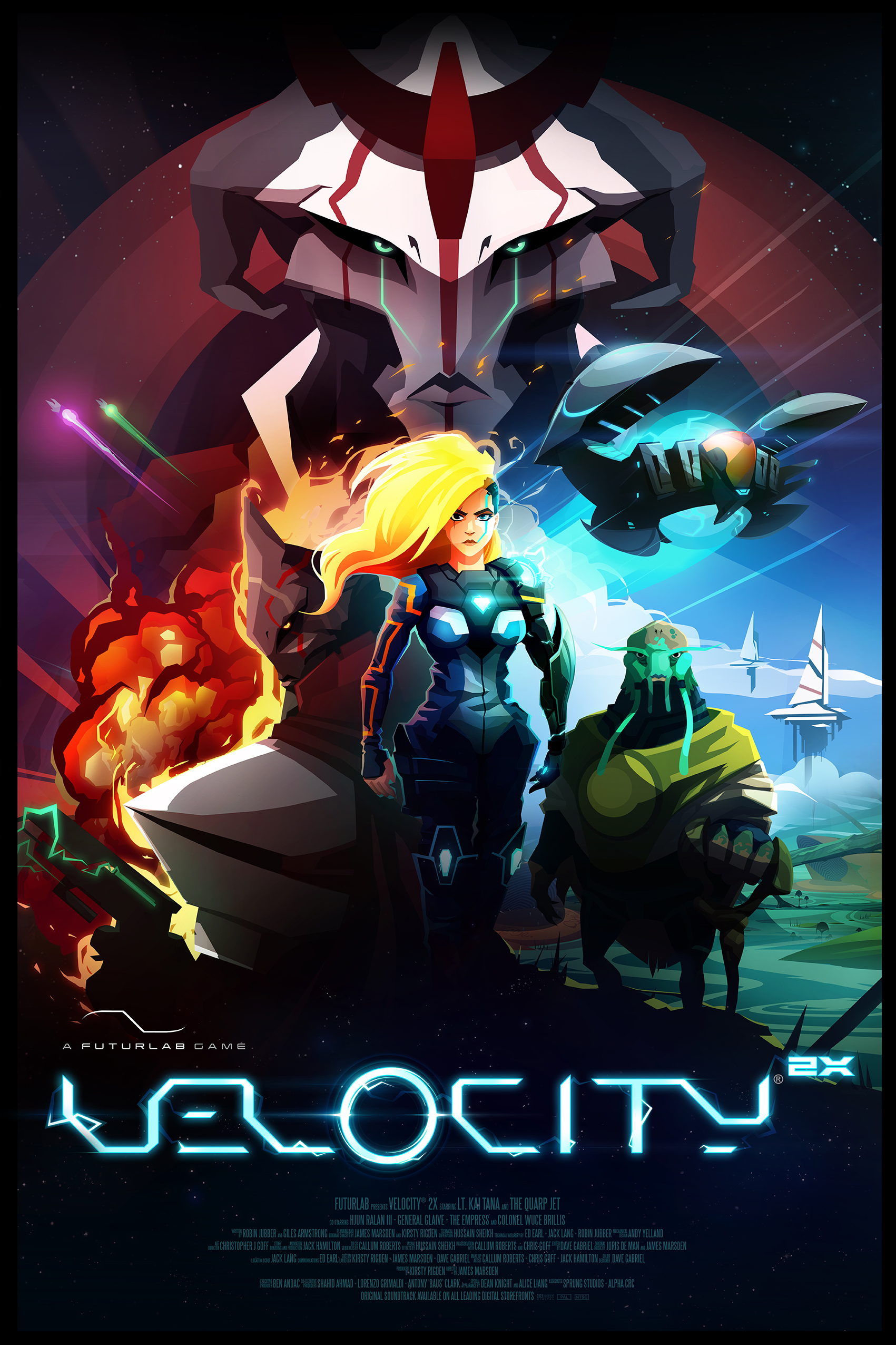
Velocity 2X Review (PSVita)

Velocity 2X
"Aw, Hell, yeah!"
What works
1. Everything is an improvement. 
The first Velocity game had a straightforward, NES-era sensibility to it, reminiscent of games like Metal Storm or Contra. The art direction and level design was simple, some might even say bland or samey, and enemy variety was a tad underwhelming, but it was cohesive and solid, everything fitting together perfectly. On top of that, it had very tight controls and unparalleled gameplay. It was almost perfect, hardly feeling like a Playstation mini
Velocity 2X might seem like it does very little to build on its predecessor, with many changes so subtle, they can be easily missed, and it's doubtful many will appreciate them. The artwork is still overall minimalistic with its textures and color palettes, but many levels have such fine details and subtle touches (like waterfalls that surprise you with a sense of height) that it's easy to get lost in the sheer beauty of certain spots.

2. Gunning and running. 
When I first saw the screenshots of the "on foot" segments, I was a little bit worried. It seemed like the step the folks at FuturLab took off the ship was a timid, cautious one that played it safe and checked with its neighbor. Frankly, it looked like an endless runner. Don't get me wrong, that would have made sense, and I love many of those games like Jetpack Joyride and Canabalt, but it would have felt like a token gesture toward expanding on the original concept. Luckily, I was so very wrong and I couldn't be happier about it. It is, in fact, a fully-realized sidescrolling platforming shooter with puzzles and exploration. There's even some combat and physics thrown in for good measure. It reminded me of Major Havoc with a touch of Metroid, all with the slick polish of WayForward's Bloodrayne: Betrayal. Kai Tana has extremely fluid and graceful animations, whether it's leaping across a disintegration field or firing her palm blaster (which makes me think of Vanessa Z. Schneider from P.N.03, a stylistically similar title I also happen to love) or even waiting for an elevator.

3. That certain... I don't know what. 
Actually, I do, but it's a little hard to describe. The short, crude version of it is: it makes you feel like a badass. Word is that the development team had to insist on a female lead even as far back as the first game, when we never left the ship. I, for one, am glad they stuck to their guns and delivered an awesome character who manages to be dead sexy, and does so on her own terms. When you're standing in a chamber of crystal deposits firing that hand cannon in a circle, shards of glass and debris falling all around you, it's hard not to let a smiling, "Aw, Hell yeah!" escape your lips. Before long, you're taking down Vokh patrols like it's second nature. You'll be flinging bombs at switches and turrets like you can see the future. You'll have distributing telepods down like a science. All, this, and you'll know it's you doing it, not some contextual action script set to Quick Time Events or button-mashing. That's a hard feeling to achieve, and this game nails it.

What doesn't work 
1. The side scrolling stages have room for improvement. 
It was often difficult to use the teledash while jumping or falling, and it would be nice if I could simply tap the screen rather than aiming exclusively with the controls. It would also be nice if your telepod inventory was separate from those you have for the Quarpjet (there's a notable size difference). I actually managed to just about break the game because I didn't realize I'd used up all my telepods back on the ship and got myself stuck. Of course, I could probably have backtracked to the ship, but since I didn't realize the inventory was shared, I thought it was a glitch. On that note, while the idea of the telepods to get through narrow hazards is great, it felt like I was having my hand held for far too long. At various points in the levels, there are these pads you're meant to stand on and aim your telepod at. I could understand these in the level wherein you're introduced to the mechanic, but having them throughout the game feels like there's no strategy to it.

2. Speaking of telepods... 
While micromanagement of telepods is vastly improved, namely the fact that you can retrieve spent pods through the map screen, the "shortcut" of hopping over to the last pod dropped by double-tapping the triangle button is a surefire way to get innards smeared across a bulkhead. At least two out of three tries caused me to drop two more pods where I stood. That double tap has to be just perfect, and I could never do it on command. The sidescrolling stages didn't have this problem, which makes me wonder if this could possibly be a runtime issue. 

3. Speed Pads Are Worthless. 
Velocity is a thinking man's shooter. In a game that already invigorates its genre by favoring pre-planning and exploration over twitch reflexes, having parts that railroad the player onto a fast track feels tacky. What's the point to the thrill of the added speed if you've got to be that much more alert with your teleporting? It's not even as though they're placed in strategic locations that would give you the best of both worlds if you were quick thinking enough to hit each one in rapid succession. To be fair, toward the end, one mission had them placed so close to upcoming walls that I had to resort to the old control method of teleporting, which was admittedly a nice touch. Still, I'd rather speed pads have been part of the DLC or bonus missions.

4. Mission 42 became the bane of my existence and nearly led to a ragequit. 
As great as touch controls are for teleporting across the map, it's not half as precise as it could be. I was convinced I'd found a bug because no amount of tapping could get me into a space after deactivating its force field. I restarted the level twice before I found out, practically on accident that the actual "'portable" area in the space is so small that even aiming the cursor with the analog stick felt like threading a needle on the roof of a speeding train.

But my absolute biggest gripe...
5. The calculator is not scientific. 

I mean, come on, guys. You know the Vita can handle it. Hell, the PSP could have done it (though the lack of a touchscreen would make things a bit tricky). I'm not looking for graphing capabilities or currency conversion or reverse Polish notation, I just want to know the spirit of the great warrior shaman SoCaToah is watching over me wherever I take my Vita.

What I'd like to see next. 
By favoring exploration, Velocity solves the problem of the Vita being widescreen. In typical SHMUPS, the gameplay favors verticality, with many arcade cabinets having their monitors mounted sideways. Velocity, meanwhile, started on the PSP, and therefore added a more pronounced X-axis to the movement repertoire. That said, I would love to see a version of Velocity that favors a vertical screen, namely a smartphone. Between Playstation Mobile and Playstation Now, I'd really love to see what Futurlab can do with more visual real estate.

Cooperative play may not be any sort of a game changer, but it may be a fun idea to explore. As a fan of The Last Starfighter (which, given some of your alien companion Ralan's lines, I think the developers are, too), it would be a great exercise in teamwork to relegate flying to one pilot with weapons and teleporting to a co-pilot.