Showing posts with label sony. Show all posts

19 July 2026

Waiting for the Gift of Sound and Vision

One of my favorite means of indulging my nostalgic needs of late is to peruse old gaming magazines that I had read in high school and some of college, late 90’s to early 2000’s. This is easy enough thanks to sites like Retromags and the Internet Archive. The scan quality isn’t always great and there’s a few gaps here and there, but the fortunate part about what I was looking for most recently is that advertisements tend to repeat month to month. If you’re very lucky, what gets advertised eventually gets featured in the magazine proper.

I don’t consider myself an audiophile. I don’t know enough about speakers to know my studio monitors from my bookshelves from my ribbons from my… whatever the speakers I was looking for are, but I know enough to know what sounds good to me. One thing I’ve learned over the years is that with the possible exception of the iPhone, the internal speaker on any electronic device is bound to be terrible. If you’re lucky, it’s terrible in a way that makes it good. The speakers in my PSP would crackle a little when sound peaked, such as during an explosion or a crash of some vehicle, but I found something oddly satisfying and reassuring about it. I know charm is an overused term, but I can’t think of a more apt term for this particular flavor of the warm and fuzzies.

Sidenote: we had our N64 hooked up to a TV whose internal speakers weren’t shielded from the cathode ray tube. Before I understood anything I just said, I was convinced the screen flickering during loud parts or bass-heavy sounds was the awesome power of the artificial intelligence written into the game’s code. The system (and specifically Shadows of the Empire) was just too damn powerful for our meager little television set.

Maybe I don’t read enough magazines, but it always felt like the ads in videogame magazines were especially creative. They were bold, edgy, funny, clever, and memorable enough that I found myself looking back through those old issues for a set of Sony speakers I saw advertised in an issue of Electronic Gaming Monthly. The ad was two pages, but it wasn’t a spread like you’d expect. The first page was a tall, narrow, black speaker with a few buttons and a green slit of an LCD. Its cord ran out from its back and to the right of the page. A few pages later, the second page showed the speaker’s mate, its own cord running in the opposite direction. The first page asks if you need a reason to get surround sound, advising you to keep flipping the pages. The second page observes that you’ve seen no shortage of reasons. A few more buzzwords about the quality of the speakers and an image of how the speakers are intended to be set up, with one on either side of a modestly-sized television. 


I think I was fascinated by these speakers, blandly branded the SA-VA7’s, because they didn’t fit any conventional models of audio setups I was superficially familiar with. It mentioned surround sound, but in my experience, surround sound required more than two speakers and they all had to be hooked up to a massive receiver under your VCR and/or DVD player. These looked more like the speakers you get for a PC, but they were so much bigger and imposing looking. Too insubstantial for the former and too over-engineered for the latter, I think the reason I didn’t inquire further into them was that I doubtless couldn’t afford them, be they a cheap surround system or an expensive PC speaker. Moreover, I already had a really nice stereo system that I’d gotten unexpectedly for Christmas, so they’d be redundant as well.

Sidenote: It’s worth pointing out here that I can be an exceptionally frugal person. My brother likes to tell this story about the time he asked me, “If you could have any car in the world, any at all, what would it be?” My response was a Geo Storm. He thought for a moment and explained that cost wasn’t an issue, that it could be any vehicle regardless of price. I stuck to my guns. In those decades since, my taste in cars has become more high roller than coupon-clipping, and I’ve also learned to distinguish between purchases and investments.

A few years later, something unexpected happened. The family computer, a Bondi-blue G3 iMac with a DVD drive, became my computer. This meant it wound up in my room on my desk, against the opposite wall of my TV, Playstation, and stereo. Obviously, hooking up my TV and Playstation to the stereo was easy and straightforward. If I wanted to hook my iMac to the stereo, I would have had to run a cord from my desk and across my floor to the entertainment center. Even if I wanted to deal with the tripping hazard, there’s the problem of the speakers being behind me while I’m at the iMac at my desk. In fact, they were behind me and to my left, so it was far from an ideal arrangement.

Along comes another issue of Electronic Gaming Monthly and with it the solution to my problem. If SA-VA7 was a bland name, these had the exact opposite problem. These had at least two names and from a brand that seemed to be in the process of restructuring, so there were two additional names. The full title of these little dynamos was the ScreenBeat Sound Station by SpectraVideo/Logic3. The apparatus consisted of two small speakers wired up to a subwoofer that was meant to sit on the floor (or on your desk if you wanted to the Jurassic Park thing with any cups of liquid you had). This made it what’s known as a “2.1” sound system, with the decimal referring to the subwoofer as that’s generally less something you hear and more something you feel. They retailed for about 70USD (I never found out what the SA-VA7’s cost) and their absolute best feature that stood out to me: they matched my iMac


It wasn’t a perfect color match, but close enough that, when I moved into my college dorm, my roommate’s dad asked if I was a computer science major. When I said I wasn’t, he asked about the tower I was setting up under my monitor. I explained that the monitor was the whole computer and the “tower” was just a speaker. That shows you how revolutionary the design of the iMac was; beige boxes were still the industry standard. The elaborate, Windows-based gaming rigs you see today were around, but they were almost rarer to see in the wild than an iMac. Simply put, it seemed like these speakers were made just for me.

A lot of time passed, I graduated college, the iMac was getting a bit long in the tooth in term of technology (and it was already admittedly a little bit underpowered for anything outside of video editing in Quicktime Pro, writing papers, making Powerpoint presentations, and simple 3D modeling in Poser), and Windows XP had fixed pretty much every complaint I ever had about previous offering from the House of Gates. So, the iMac went away and my proper PC tower became my monolith to all things media and productivity. The ScreenBeats had gone away somewhere in this timeframe, either before I graduated or just after, and I mostly stuck to using headphones if I was going to be immersed in whatever I needed the PC for.

A lot more time passed and the most elaborate sound system I had was a speaker bar for my TV and game consoles. If I was using a computer or a phone or a tablet, headphones were my default. They were also the default for when I listened to music as I was in an apartment and I didn’t want to be THAT neighbor blasting music through my speaker bar. Of course, I watched plenty of movies and played plenty of games through that speaker bar, but that just seemed different to me somehow, like it would be more forgivable or bearable than going through the entire Daft Punk discography. Also, my roommate has little to no concept of an indoor voice when she’s gaming on her PC and headphones were the best defense.

Toward the end of my time in that apartment, I was watching a YouTube video from a games reviewer named Caddicarus. This particular video was sponsored by a company called KOVE and the product on display was a cylindrical Bluetooth speaker that fit nicely into the cupholders of a car, likely hence its name of the Commuter. When I checked out the website, I saw KOVE had a new speaker on offer called the Commuter 2 (which they changed recently to a "K"), the sequel to the speaker I’d just seen. If you’re in the market for a Bluetooth speaker, KOVE is a little hard to recommend. I think they’re a drop-shipping operation. That is, KOVE is the branding middleman for a generic speaker you can probably find cheaper elsewhere under a different name. It’s also one of those sites that is running flash sales all the time, so it’s virtually impossible to pay the full advertised price for the speaker. I know there’s a name for this advertising tactic, but I can’t be bothered to look it up. Needless to say, the speaker was cheap despite being advertised on a massive sale, but like those iMac matchers from years ago, they had a little special something to them that intrigued me. I took the chance and got my 200USD speaker for a mere 64 (which is technically less than what I paid for the Sound Station if you consider inflation). 


The intriguing feature was the ability of the speaker to split into a stereo pair. It twisted in the middle with a bayonet-style locking system and this middle seam was actually angled in such a way that the two halves would rest with their drivers aimed slightly upward. 


Did I think this was an absolutely inspired piece of design? Very much so. Did I ever actually use it when I was writing on my iPad with my little keyboard and case that folded into a stand for the iPad? Maybe once. I mean, I wasn’t about to set this up in a coffee shop. An especially clicky mechanical keyboard? Yes, I’m THAT guy. Speakers? No, that’s just plain obnoxious. 


I ended up giving the speaker to my roommate. It wasn’t a hard decision because, despite the intriguingly cool design, the KOVE Commuter 2 had a crippling flaw: latency. If you were simply listening to music or an audiobook or a podcast, there was no issue. If, however, you were watching a video, you’d notice a bit of a gap between the lips flapping on the screen and the sounds hitting your ear. If you were using a music-making app like GarageBand or a digital instrument of some kind, forget it. It was at least a full beat behind, making it practically unusable. I have no idea why it has this problem; I don’t have this issue with Bluetooth headphones. My best guess is it’s something to do with the way the two speakers are tethered together, since you’re still only connecting one speaker to your source. It must simply be too much number crunching to receive the signal from the device and then beam the other channel to its mating half. Maybe this is why I’ve never seen another Bluetooth speaker like this one, why I don’t see this stereo splitting by other companies like SONOS or JBL.

As for replacing my KOVE, I came across a slender little number from Sony, the SRS-XB23. It didn’t split in two, but could still play a stereo signal through its two drivers, requiring you to place the speaker on its side for best results. I paid roughly less than the Commuter 2, it fills the room quite nicely, and there’s no latency when I’m watching something on my phone or making music.

A few weeks ago, I was thinking about those old SA-VA7’s from the magazine ad and did a little investigating. I found exactly one YouTube video of someone showing them off, along with some scattered pages in various audiophile databases. Overall, they don’t seem to have sold very well, which may be attributed to Sony marketing them to gamers to use with their Playstations. If gamers are going to hook up their consoles to a sound system, they’re probably just going to do what I did and use the one I had for music anyway. That was when an idea hit me. The SRS-XB23 may not have had the ability to split into two speakers, but there is a feature that plays right into the devious marketing of those bigger audio equipment companies like JBL or Bose: Stereo pairing.

It’s simple enough in principle. If you have two of the same model of Bluetooth speaker, you can pair them together so that one is the right channel and the other is the left channel. This is the “that’s where they get you” of the scheme. Why sell one speaker that does the work of two when you can have two speakers at twice the price? The SRS-XB23 had been out for a few years and was still available as New Old Stock on Amazon. In fact, I got it from the same third-party seller for about the same price.

Although simple enough in principle, actually setting up the stereo pair is a little bit tedious. For starters, I’ve already got one SRS-XB23 saved in my phone’s Bluetooth settings, so now there’s another identical speaker to add to the mix and I can’t just nickname them like some other devices. Secondly, you’ve got to pair the speakers with each other first, which means you have to turn off Bluetooth on the device you’re ultimately going to tether them to. Tedious may be a strong word, but it’s not very intuitive and certainly not discoverable without consulting an online guide. Once you’ve got the stereo pair sorted, each speaker conveniently announces whether it’s the left or right channel. Finally, you turn the Bluetooth back on your device and hope you pick the correct of the two identical speakers and you’re off to the races in stereo and with no noticeable latency.

Am I going to use this setup? No. I don’t do a lot of writing on my iPad anymore since I’ve got a recently upgraded desktop setup that I plan to get as much use out of as humanly possible. As for using them with my desktop (music coming from my iPhone and to the speakers) my monitor is too wide and my desk is too narrow to place them at each side as intended. Did I waste my money? I don’t think so. I’ll still use the stereo pairing on occasion. They sound great in tandem, plus I’ve got one as a backup given the first is almost 5 years old at this point and with semi-regular use. Most importantly, after 30-some years, I finally have (the option for) two tall, narrow Sony speakers on either side of a display.

21 August 2022

Get Gex Going

It's not even funny how much I want this to be a real thing. I'm sure Dana Gould wouldn't have minded the extra work, either. 

Gex is a painfully short-lived series of games about a TV-obsessed, wise-cracking gecko. It began life on the 3DO console and, much like Crash Bandicoot for the original Playstation, became a sort of de facto mascot for the system (as well as for his developer, Crystal Dynamics). I only ever knew one person who owned a 3DO. He was a friend of a friend, and he got more use out of it as a CD player than a proper games console. This was likely a typical story as Gex didn't stay exclusive to the 3DO, getting released on the Sony Playstation, Sega Saturn, and PC. It was a serviceable 2D side-scroller, its main draw being a more diverse variety of locations beyond the typical terrains common to Super Mario Bros. or Sonic the Hedgehog (fire, water, ice, etc.). Gex's abilities to interact with these environments was also notable. Mario could jump high, Sonic could run fast, and Gex could stick to walls and ceilings. Reviews of the time were middling, at least when it came to the Saturn, Playstation, and PC ports. The 3DO version would be well-received, if only for the platform creating such a low bar for quality. 

I only played the first game a few years ago on the Playstation 3. Gex's moveset was definitely its best feature, but the level design left much to be desired. Playing off of Gex's wall crawling, exploration was encouraged over more straightforward, left-to-right layouts. Unfortunately, there often wasn't very much to explore, leading to a lot of backtracking. 

Despite a lukewarm reception, Gex did get a pair of sequels in fairly rapid succession, this time in full 3D on the Playstation and Nintendo 64. At this point, a number of well-known videogame mascots were trying to make the leap from 2D to 3D with relatively mixed results. Mario hit the ground running with Super Mario 64 and Sonic would have some awkward first steps on the Saturn (Sonic 3D Blast and Sonic R) before getting a decent foothold with Sonic Adventure on the Sega Dreamcast

While I was aware of these sequels, I never played them as I was busy with RPG's, racers, and fighting games. Also, rentals of Donkey Kong 64 and Banjo Kazooie put me off of the whole 3D platformer genre for some time, with their large but mostly empty levels and ludicrously lengthy laundry lists of largely insignificant items to collect. In any case, I was glad for some variety in the space, as Gex didn’t seem to share the same flaws as his lesser 3D brethren. Sadly, it didn’t have many strengths on offer, either. 

This N64 cover art was also used as a marketing image for the game. 
 
The operative phrase when discussing the reception of any Gex title is, "Not for any lack of trying." Some may argue it was the dawn of the internet that caused Gex to fall by the wayside, that a TV-obsessed gecko wouldn't be relevant in an era when more and more people were beginning to look to the web for content. For my money, Gex was never so topical. Many of his references were from sitcoms and shows predating his game by several decades, so being out of touch is par for the course. Frankly, the most topical Gex ever got was him becoming a secret agent in the sequels, as Pierce Brosnan's portrayal of James Bond was hitting its stride at the time with Tomorrow Never Dies and The World Is Not Enough. If newer efforts were to have him spouting modern memes or other varieties of internet humor, he’d likely be met with the same reception as a certain cartoon dog who died on the way back to his home planet. 


Speaking of sitcoms and animation, it may well be that FlippinDingDong’s tribute is more on point than anyone realizes. Both Mario and Sonic have had several animated programs dedicated to them, to say nothing of Mario’s overall longevity keeping him in the public consciousness. Even Bubsy had a pilot, and he’s gotten a revival in the last few years. Whether that translates to any long-lasting success remains to be seen, but it’s hard to ignore the correlation between having a mainstream presence and a gaming IP enjoying a longevity. Gex rose and fell within a single console generation. There were plans for a Gex 4 on the Playstation 2 and Gamecube, but it was canceled at the concept art stage. The most recent news about the gecko came in 2021 and 2022 when Square Enix registered trademarks for Gex in the EU and Japan, respectively. This was a few months before Square Enix sold off its Crystal Dynamics/Eidos properties to a holding company known as the Embracer Group. At the time of this writing, it's not actually known for certain if Gex was part of the sale. It's possible Square Enix held on to him and is planning some kind of revival. 

We'll just have to stay tuned. 

02 August 2022

Final Fantasy Follow-Up

 OR:
When It Was Hip To Be With Square

I wrote my last entry about Square Enix’s legendary franchise before learning of the company’s most recent plan to sell FFVII-based NFT’s, a move that is quickly earning them a tumbling snowball's worth of backlash and criticism. It got me thinking about the history of the company, especially when the Playstation came on the market. This is by no means an exhaustive nor comprehensive history, merely a general impression from an outsider's perspective. During the 16-bit era, hey were known for publishing titles to the Super Nintendo, Final Fantasy III (technically VI, but that's another matter) being one of their most acclaimed releases. Squaresoft, as they were known back then, was leery of Nintendo’s insistence on cartridges over the CD-ROM format. On the other side of the great dividing wall between Nintendo and Sega, the Sega CD, despite not being financially successful, demonstrated how RPG’s and strategy games could benefit from the extra storage space, if only in the presentation department. Thus, their decision to abandon Camp Mario for the greener pastures of Sony’s gray underdog was made. 

Squaresoft went all in on Playstation’s promises of a bigger and better medium for their games, and I was there for it. I didn’t necessarily buy every single release, but I followed every announcement diligently. New games seemed to come out weekly. Not all printed money like Final Fantasy VII, but what hits they had were obviously more than enough to buoy their b-list brethren. It felt like the company was willing to take risks on more niche and obscure titles others would pass on, maintaining a faith the financials would work themselves out somehow. 

About halfway through the PS2’s life cycle, Square seemed to begin losing their way. The bubble birthed on the back of the PS1 hadn’t burst, but the surface tension was beginning to show signs of weakness. Focus was shifted to their major franchises like Final Fantasy while other established titles were allowed to languish by the wayside. The excitement of the new frontier was long gone, and they fell off my radar. I’d still keep an eye out for what was next for the Final Fantasy franchise albeit I’d stopped playing the games around the release of IX, last part of the great Playstation One Trilogy. Overall, though, I’d lost interest in RPG’s and started looking to other, more action-oriented genres. I often joked I had an abusive relationship with role-playing games, that I loved them dearly but had no time for them. Kingdom Hearts was probably my point of saturation. It was a good note to end the relationship on, an overall well-made game whose only real fault was an off-the-rails story that, as I've heard from even its most devoted fans, didn't get much more coherent in the sequels. 

I do genuinely love this image, albeit
I can't help but think they're up there looking for the lost plot. 

When it came to the PS3, I found myself practically ignoring Square Enix (as they came to be known then) beyond a passing fascination with Final Fantasy XIII and one of its spin-off games. After that, it was off the radar again. The next major piece of news that caught my attention was their acquisition of the Tomb Raider franchise, giving it a fresh, gritty reboot I met with almost complete indifference. Nier: Automata held my interest for a bit, but had much the same problem as Kingdom Hearts, with a gonzo story nobody seems to have a full and proper handle on. This was the time of the PS4. From what I can tell, the PS5 isn't going to see much from its old friend. Tomb Raider, along with a number of other IP's, has been completely sold off to a holding company in favor of some Crypto currency venture I don't pretend to be knowledgeable about. 
This is no longer a label that piques my curiosity nor captures my imagination. I don't recognize it from its heyday.
And this one just makes me sad. 

Calling them sell-outs is admittedly unfair. They're not so risk averse as to only bank on Final Fantasy and their merchandise which they're just as quick to advertise as any of their games. They have a wide range of titles currently on offer, and when I look upon Power Washer Simulator, part of me is assured they haven't changed as much as it may seem. Square-Enix has changed to be sure, but so have I, and maybe that's what I'm really sad about. 

What I really want to know at this point is, given the sale of their former Eidos properties, who owns the rights to Gex?

01 January 2021

(Un)Lucky Number 7: Putting It All On Green

I couldn't find a good way to transition to this from my earlier part about finding out one of my cables went bad, so I decided to make it a separate entry. 

A handful of my coworkers had mentioned recently "going green" as in trading their apples for androids. I can certainly understand the frustrations people have with their iPhones, be it the dreaded "Apple tax" or the toy-like interface. Seriously, when I had to send in my Xperia Z Ultra to get fixed, and I got a 5C to use in the potentially 6-8 week meanwhile, I laughed when I first swiped through the menu. For starters, the screen was absurdly small compared to my Sony Phablet, which was as much a digital sketchbook as it was a phone. Then there was the notable lack of widgets. Apple has finally fixed this, though I almost hesitate to call it a fix as they weren't anywhere near as useful as they could have been on my Android. Maybe I simply didn't have the kind of workflow that benefitted from some of them, but nonetheless the "icons-only" screen that rolled out in front of me felt like a step down and backwards. On the whole, the sole saving grace of the 5C was the camera. I could certainly take photos and shoot video with my Android, but somehow it always felt more than a little bit unpolished, like it was an afterthought in the design. This was especially annoying because this was a Sony product. I'd used Sony camcorders back in high school and college, to say nothing of all the other Sony products I'd owned like various TV's or my minidisc or certainly all of my Playstation stuff. 

In fact, when the Z came back from getting its battery fixed, I kept the 5C around to use as a camera, though mostly for around the house whenever the cats did something cute or I wanted to shoot a video for my YouTube channel. A few months of that arrangement later, and I inadvertently warmed up to the idea of the iPhone being a permanent fixture. I was about to go on a trip to see family, and I didn't want to bother with bringing two cables/chargers, so I "temporarily" activated the 5C again and left the Xperia at home. As the saying goes, I went Mac and never looked back. Given my favorite feature about the Ultra was its screen, it only made sense to phase it out. I'd migrated all of my drawing workflows to my iPad, so a phone with a big screen was rather unnecessary. The 5C was so lightweight in the same bag as the iPad compared to the Z I moved it to my pocket because it was possible I'd forget to pack it in the morning. 

The 5C eventually got traded in for the SE, and that's still one of my favorite iPhones. That got traded for the 7 I currently have now, and that's been an unremarkable upgrade despite my initial hype when the was first announced. Of course, it's been a few years since then, and I'm far more impressed with the newest version of the SE, as I previously wrote about.

Here's my perspective, apart from them being easily by far the best cameras I've ever owned (that don't have interchangeable lenses or true optical zooms), what I like best about my iPhones is how they play nice with my iPad. They also play nice with my Mac miniAirdrop alone has been a legitimate lifesaver. Forget those Apple stickers you get with every purchase, where's my Airdrop sticker? 

28 April 2019

When To Hold 'Em, When to Fold 'Em

So, we've had two major developments in consumer technology, both having to do with flexible displays. The first of these is the delay of the Samsung Galaxy Fold phones, following a number of review units breaking. Some of these incidents were due to user error, namely the removal of what appeared to be a screen protector from the display. Others seemed to be simple wear-and-tear in a relatively short amount of time. First iteration gremlins aside, the device does not seem to be offering what users expected in terms of form and function. Marques Brownlee in particular noted the clumsiness of the hinge and how more often than not it simply felt like he had two small phones in his pocket rather than one large one. He did give the device a little credit when he addressed viewer concerns of the "crease" in the middle of the display only being noticeable in certain lighting conditions and/or whenever users are actively looking for it. 

The hype over the folding phones, the various proof-of-concepts teased last year and a few prototypes for hands-on demos from the likes of Huawei, is completely underwhelming to me. I have absolutely zero use for a folding display. I'm hard-pressed to think of an instance in which the thought occurred, "If only I could fold up this display and tuck it away." That's not entirely fair, though. If one of my Moleskines could bend and give like a softcover when I don't need it and lay flat as a hardcover when I do, that would be pretty cool. Trouble is, that's not what the Fold, nor any other folding display phone, is offering. What it's offering is to open and close like a book, but display as a single page. Contrast this with two devices, the Nintendo DS and the Sony Tablet P, and suddenly the Galaxy Fold becomes a solution looking for a problem, a step down from a novelty. The DS had more than a few titles that had the user hold the DS on its side, with the left and right screens displaying pages like a book. The Tablet P never quite made the most of its dual displays, but that was more of a software issue (Android) than a hardware problem. 

Still, I'm not being fair. As I said, I have no use for a folding display. I'm clearly not the target audience for a device like this. It all speaks to a fundamental disconnect between how I see tablets, and how the general public sees them. I think my brother put it best when we were talking about the original iPad back in the day. I was expecting a productivity machine, a touchscreen Macbook, not an oversized iPhone. From this perspective, the iPad is terrible, a step back, borderline insulting to the creative spirit of Apple users. However, as a consumption device, a means for appreciating various media, it's a Victorinox-style music player, television, and e-book reader. Time has blurred this line, with no shortage of productivity apps along with all the fun stuff. The iPad is still far from being the laptop replacement Apple wants us to believe it is, but it can certainly hold its own against a Chromebook. It's still my choice platform for making digital art. From that perspective, the Galaxy Fold is terrible. I can just see it folding up in my hand as I push down with my stylus just a little too hard, or my lines across the middle not being nearly as straight as they could be, little hiccups interrupting smooth pen strokes. 

I haven't yet found a single Fold review in which anyone attempts to use Autodesk Sketchbook or Medibang. Between that and Samsung not enabling the S-Pen for it, I'm thinking it's either so extraordinarily unremarkable it's irrelevant, or my visions are prophetic. The simple fact is that carrying around an iPad Pro just about everywhere is something I resigned myself to. It's no more of a hassle or headache or added bit of bulk than when I carried around an 8 x 5 sketchbook everywhere. 

Speaking of carrying something around everywhere with little to no hassle, the second recent development may have its own share of issues, but I'm far more optimistic about it than the Fold. The Nubia Alpha is easily the smartest use of a flexible display I've seen thus far, its focus being less on folding and more on wrapping. It's not trying to put a bigger thing in a smaller package. It's doing something entirely different. It's invented a new form of screen real estate, expanding the clock face onto the rest of the band. It rather reminds me of Sony's little-known "smart wristband" the Wena, which lets you keep your existing watch while delegating the smart features to a tiny display in the band. 


Remember what I said about wanting to be able to roll and bend a Moleskine softcover yet have it lay flat when I needed to draw or write in it? Well, the Alpha isn't trying to be that for me. It doesn't have to, and I would never ask that of it. It's not exactly on any wishlists of mine right now (I'm no early adopter and my FitBit works just fine), but I'm watching this far more closely than any other flexible display out there. 

30 March 2019

Playstation Plus

The newest round of free games was announced for Playstation Plus a few days ago and it made me a little sad. It's the second month since Sony announced that PS3 and Vita games would no longer be featured in the monthly lineup of free games for members. This was inevitable; the PS3 had long since proven it could have a 10-year life cycle and even beyond, once and for all debunking that arbitrary 5-year cycle that somehow came to be accepted as fact somewhere between the 16-bit generation and the first Playstation. Still, it leaves me a little melancholy as the last 2 months of offerings have only yielded 4 games in total. It's clear Sony is trying to make up for the lack of platforms by offering fewer, but higher-end games. Before that, a player would get maybe a half-dozen total titles, most of them smaller, indie games or older titles that already had their time in the spotlight. 
Without getting into some long-winded explanation for what Plus is, the best way to describe it is a Jelly-of-the-month club. If you're old enough to remember Time Life books or if you're a fan of monthly subscription boxes like Loot Crate or Blue Apron, you've got a pretty good idea of how the system works. The important added caveat is that if you ever cancel your Plus membership, you will not be able to play any of the free games you've gotten up to that point. That's probably the dealbreaker for a number of people, that they're not so much "free" as much as they're "included," which is perfectly understandable. 
The first two games I ever got while having a Plus membership were Lara Croft and the Guardian of Light and Warhammer 40,000: Space Marine, which meant that first year pretty much paid for itself. This trend continued with some dry months and a few awesome months, at no point ever feeling like I was paying too much. It was set-and-forget as far as I cared. I've built up a massive, massive library of games. I don't think it comes anywhere near the library of my PS2 back in the day, but it's sizable nonetheless. It's big enough that I feel a little guilty when I buy a game. I'll often go through the list beforehand to see that I'm not buying one type of game when I've already got a perfectly good example of the genre on hand. Unfortunately for anyone jumping on board Plus right now, they don't get that back catalog as I've taken advantage of. 
PSPlus is not for everyone, and that's especially the case now. while I don't plan on getting rid of my Plus membership anytime soon, let it be known the selection is going to have to work that much harder to impress me every month. I'm more likely to recommend PSNow than Plus to anyone getting a PS4

16 June 2018

Driving Miss Daily

Once upon a time, Douglas Adams had a radio show with a totally uninspired name he couldn't tell enough people wasn't his idea called The Hitchhiker's Guide to the Future. It only had a few episodes and has only aired every few years, but it's easily-available on the Radio 4 site... wait, what in Hel's Realm is RealPlayer? Anyway, their last episode was about the idea of convergence, what we today may refer to as the Internet of Things. IoT is a common name in the hacker/maker/modder community and refers to a networking of several specialized devices. Probably the best, most common example of IoT if you're still lost on the concept would be any sort of peripheral you can control with your smartphone, like a bluetooth speaker or a lighting system. Instead of one gadget that does everything, it's several gadgets that do a few things. Almost 20 years earlier, for this radio program(me), one of its speakers painted a scenario in which the technology to make connected devices would be so streamlined and inexpensive you'd literally pick up a gizmo off the street, post something, and then drop it back on the ground before carrying on with your day. Hyperbole aside, while we're nowhere near using our tablets the way some countries use bicycles, there's probably a drawer somewhere in all of our homes that would make anyone from back then think we'd made it. 
Unless you're crazy diligent about trading in your smartphones or you've got some wicked protection plan for your tablets, you've likely held onto more than a few. Those that aren't taking up real estate in your junk drawers are probably lucky enough to be dedicated music players, alarm clocks, cameras, gaming devices, and maybe even digital sketchbooks. Such was the case for my Xperia Z Ultra, a very early entry into the "phablet" market, and still impressive in terms of size and resolution. It was my gateway to a fully-digital workflow. I'd done digital art before when I had my laptop, but I was still scanning drawings and bringing them into GIMP as layers to rearrange and edit. I'd long since given away my little Bamboo tablet because I never got used to the hand-eye disconnect, and I didn't have a mouse to get around the hassle of using a trackpad or trackball. My first Android phone was so small and the drawing apps available were so rudimentary I never bothered with that either. When I got that Sony, however, it was a whole new world, especially when I came across Zenbrush. Between that and Pixlr, it became my daily driver. I ended up giving away my laptop because I stopped using it. I still don't have a proper home computer apart from the old Chromebook I mentioned in my last journal entry. Over the next few years of having the Xperia, I started to move away from the single device setup into a multi-gadget workflow again when I decided I wanted Zenbrush 2, which wasn't going to be available for Android. That was when I resolved to get my first iPad, the mini 3. As you might imagine, I started using the Xperia less and less for drawing. Later on and totally out of the blue, I had to send my Xperia in to Sony to fix a bricking issue. This was going to take some time, so because I'd bought the phone unlocked, I had a golden ticket with my cell carrier to get just about any phone I wanted. I'd been seeing some YouTube videos about shooting videos using only an iPhone, so I thought I'd give that a go. I got my iPhone 5C, used it for a few weeks and fell in love with the camera so much that when I got my Xperia back, I kept the 5C as a dedicated camera. Following Inktober 2017, I upgraded my iPad to the Pro, and sent off the mini 3 with the 5C to an Alzheimer's charity to be repurposed as music players for the elderly. I was also eligible again for an upgrade with my carrier, so I got the SE to use as a backup in case I needed to send in my Xperia again. January rolled around and for my trip to Albuquerque to see family, I decided I didn't want to bother with two chargers (as my iPad goes with me everywhere), so migrated to the SE and simply never bothered going back to the Xperia
This created kind of a goofy situation that probably shows off how persnickety I can be more than anything about convergence. As I only use my iPad for drawing, and the SE's smaller screen isn't always desirable, I used the Xperia around the house for music, Twitter, Comixology, and occasionally drawing. Unfortunately, it's developed a fatal flaw. 
I'd looked into sending it in to Sony again a few months ago because its USB cover had broken off. It turned out whatever protection plan I had in place that let me get it fixed the first time wasn't available anymore and I never realized how long I'd had it. They literally told me to find a third party to fix it because they couldn't even give me an Out Of Warranty repair quote. This had happened before I migrated to the SE, so maybe I unconsciously saw the move as inevitable. It was also reaching a point where apps like Facebook and Instagram stopped working because its version of Android was so old. 
Fast forward to about a week ago, when I set it to charge up overnight and awoke to find that it couldn't get past about 74% battery life and was hot to the touch. I didn't think much of the heat because it's got a big battery with a charger that pumps a lot of amps through it, so hand-warmer was also on its list of duties. I figured something got jostled loose or maybe the wall adapter was going, so when it drained down to critical, I plugged it in again and left it plugged in all day. When I turned it back on, it was still stuck around 74%. I discovered that the instant I plugged it in, my app that monitors my CPU temp would immediately warn me of overheating. Using a different wall adapter with a lower amperage made no difference. Either the charging circuitry inside the phone was going out, or the battery itself has finally lost its full capacitance. My money's on the former, but in either case the only way I get more than a few hours of use from it is to turn on its Ultra Stamina mode, which only lets me access a handful of applications (mostly phone and camera related), reducing it to an alarm clock that is literally on its last day unless I decide to tempt fate and charge it up again. 
The app that took up the most space was Autodesk Sketchbook, and while I had backed up PSD files of most of my stuff some time ago, I realized how long it had been, so I spent about an hour one night when it was plugged in backing up everything to Google Drive.
Let that be a lesson to you digital artists out there. Even if you've already heard it, here it is again. There are two types of backups, those that fail and those that haven't failed yet. 

BACK... UP... YOUR... STUFF  

How long ago did you do that? Too long. Do it now. How many storage solutions have you got? Not enough. Get one more. 

Anyway, it's not like I stood to lose anything super precious; even when I drew on the Xperia, they were often silly little comics or cartoons for blog posts or Twitter. Still, it's an important habit to keep up, and I only wish it was this convenient and streamlined back in the day of using Zip Disks on my iMac

This marks the end of an era, with Hanging Lanterns as the last painting on my Xperia Z Ultra. Thanks for everything, big guy. 

I think 4 years is a pretty good lifespan for a smartphone. 

01 August 2016

Double Down on DS

NOTE: This op-ed is based on very loose hearsay, speculation, and partial evidence. The very nature of the Nintendo NX is subject to change between the time of this writing and its eventual release. 

The console market is in a place of uncertainty for the first time since the early 1980s. Sure, the uncertainty principle has followed consoles from day one, but if we look at the facts, the years have seen a dwindling number of advantages consoles have held for consumers over PCs in the last fifteen years. The Dreamcast introduced a built-in modem in 1999, whereas previous attempts at internet support have been aftermarket accessories like the Satellaview or the Sega Channel. Despite this, the idea of distributing games over data lines was years away from viability, with the 64DD, PS2 Hard Drive, and Phantom Console's graves as trail markers. Now, hard drives and internet connections are standard, along with digital storefronts and infrastructure for downloads and even streaming. Put simply, the line between consoles and PCs has been completely blurred, the only true differences having more to do with politics than hardware. PCs are still fundamentally the wild west while consoles are gated communities. Literally anyone can develop a PC game, and even get it released through a proper online store like Steam or Humble Bundle. Console developers have to offer their firstborn just to be put on a waiting list for a development kit. Granted, that line is blurring, but there's very little point in waiting for the treaty to be signed if the arms race is already over by way of stalemate. 

Between Miitomo and the runaway hit Pokemon GO, Nintendo has shown they're not above going to third parties for hardware, the taste of Philips out of their mouth at long last. Still, what we've always loved about Nintendo is how they go their own way, for better or for worse. Though they may have tread lightly in bringing the NES to America, compromises have been few and far between, much to the chagrin of developers, publishers, and even gamers. The Super Nintendo sold well enough, but if not for the Mortal Kombat blood controversy and Sega looking the other way to EA bypassing normal publishing channels to bring Madden to the Genesis, the SNES could have buried the competition as the NES had done to the likes of the Master System and Atari 7800. The N64's use of cartridges (in)famously drove away powerhouses like Square to Sony's bed, alienating those RPG fans who had cut their teeth on the SNES. Again, it sold well enough, but we have to ask what could have been. Similarly, the GameCube was a reasonable success, but now stands as Nintendo's second worst-selling home console, after the Wii U (we won't count the 1973 Color TV-Game since it's a Pong console), owed again to a proprietary format and a reluctance to play ball with third parties. 

Meanwhile, in the portable and handheld market, Nintendo's only true blunder to this day is the Virtual Boy. Otherwise, even the weakest link in the Game Boy/GBA/DS chain has been a license to print money. It's almost hilarious how people would forgive serious flaws like a blurry, spinach-green display on the original or a dim-as-moonless-midnight screen on the Advance and still send the things flying off the shelf. It took Sony pouring buckets of money and marketing into the PSP to even make a dent in that wall (Rest In Peace, Neo Geo Pocket Color). It finally took the iPhone to make Nintendo sit up and notice they weren't alone in their dominance of the handheld market. As much as I laughed at the prospect of iPhone/Android games and still hesitate to call it a serious platform, just like consoles, the line is blurring and it's all getting better. I still love my Vita, and I still have my original PSP, and if I could only have one, I'd take either of those over the best iPhone or iPad any day. The problem, the final hurdle for mobile phones and tablets to overcome, is the interface. Touch controls and gyroscopes do not give the same satisfying, tactile feedback as buttons or even knobs. Nintendo seems to understand this. That's why I think they're making a legitimately smart move in presenting the NX as a souped-up gaming tablet, following patterns laid down by the likes of the NVidia Shield or the Wikipad or some of Sony's Xperia devices. Some may be scratching their heads, but I think this move is the best decision they've made in years. They're still going their own way as they always have, it's just down a trail they blazed years ago. 

28 February 2015

Auvio Headphone Amplifier Review

I like to think I've got pretty good hearing. I don't regularly attend concerts or trade shows, and before I got moved to a quieter building at work, earplugs were my best friends. As such, I've never quite understood headphone amplifiers. I'd heard of them, of course, but only in terms of gear for video and stage crews, people who need that extra boost to hear directors and stage managers over the crowds, pyrotechnics, and walls of Marshalls. As for everyone else, it seemed a bit pointless. Even then, what ones I saw for consumers were specifically marketed as assistive listening devices--hearing aids for people in denial. 
A few years ago, a revelation into the sheer scope of headphone amps available came to me when a game designer I follow posted an image of the FiiO E09K dock into which was inserted an E17. At first, I couldn't even figure out what the damn thing was (I thought the E17 was an mp3 player), literally researching and double-checking my research utterly convinced I was missing something. There was simply no way something could cost that much that was little more than an upgrade to a volume knob. Even considering the existence of bling culture, the handbag industry, and lowriders, it seemed an asurdity. 
I mean, if you had that kind of dough to spend on an amp for headphones, wouldn't it be more prudent to simply buy better headphones? It made me think of that ad for Rhino TuffGrip that showed the signature spray-on spackle applied to a Chevy SSR bed, irreparably coating the hand-polished wood runners. 
It turned out even FiiO thinks their stuff is overkill, and most of their product photos show the amps hooked up to earbuds and strapped to the backs of smartphones.
That's when I kind of got it. 
Remember how expensive the Macbook Air was yet had one of the worst onboard cameras ever made? That's really where FiiO's bread and butter seems to be; lending better audio to devices that skipped out on it despite higher price tags. Granted, that still makes it an impossibly niche market, but no longer a complete absurdity. 
Moreover, I learned that the amps don't merely raise the volume, but actually enhance the sound by picking up the slack for the built-in amps of the device they're connected to. I was skeptical of this, as audiophiles tend to be the homeopathic, free energy flat-earthers of the tech world. There's also the fact that a headphone amp doesn't bypass the internal amp of the device, although I'm sure a sound engineer could fill me in on what I may be missing in this equation. 
Recently, I went to Radio Shack to exploit their financial failings by way of their everyhing-must-go sale and picked up, among other things, a tiny headphone amplifier. In fact, I got two in case I wanted to take one apart. It's from a company called Auvio, whom I'd never heard of before and suspect they may well have been exclusive to Radio Shack. I won't tell you how much the markdown was, but the initial retail price was around 30USD, very close to the now-discontinued FiiO E6. It's about the size of a matchbook with a nice, rubbery finish and capped off with a brittle-feeling clip that I don't trust one bit. Despite its size and notable lack of heft, it's surprising the level of pure tech under that tiny hood. 
Going back to what I was saying about enhancing the audio, it's true that most lower-end headphone amps are simply volume boosters, but some have equalizers built into them. These isolate certain frequencies and bring them to the forefront, namely bass and treble. The trouble with most audio players (specifically devices for which music player is an afterthought) is that the internal amplifier circuits aren't well-made, effectively homogenizing the deep bass and high treble sounds, robbing them of their respective nuances. 
The Auvio's EQ has three settings apart from "OFF" which are indicated by a slick little LED just under the top of the clip and toggled using the power switch. Blue boosts both bass and treble by 5dB, Red boosts bass by 10dB, and pink boosts treble by 5 and bass by 10. It doesn't sound like that much variety (where's the setting that boosts treble alone for, say, spoken word or talk radio?), but the effect on my PSP was surprisingly remarkable. 
For this test, I used three different headphones, all Sony (shameless fanboy here) and all over-the-ear: a low-end mdr-zx300 with a lovely metallic red finish, a mid-range noise-cancelling pair (mdr-zx110nc) and the gold wireless headset for Playstation. The noise-cancellers are my personal favorite, but possibly a bit of overkill with the amp. The mdr-zx300s, on the other hand, sounded great. My testbed, apart from some Pink Floyd, was Falcom's magnificent Ys series, namely Seven and Oath In Felghana. Followers of the flame-headed Adol Christin are likely nodding their heads right now; few franchises have such consistently awesome soundtracks, perfect for testing sound gear. Although none of the settings were really a good fit for either game, they did help give those power rock tracks that added "oomph". The effect was a bit lost on the wireless headset, but that's more a matter of ergonomics than quality. They're not exactly made with the PSP or even the Vita in mind. I can't speak to the volume boost feature, except to say I had it about as low as possible, and it still sounded great. 
Does the amp make the PSP sound better? Yes, but I don't think it's enough to recommend seeking one out. Having the ability to EQ the output was a nice touch, leagues above the presets, but that doesn't make them worth the price tag, even at the marked down price. As I said, it's better to simply get higher quality headphones, ones that emphasize bass boost. If you want the absolute best sound out of your PSP games, the best option is to play them through a VitaTV and use your home sound system. Obviously, that option's only for you if you don't care about portability and your game was a download rather than on a UMD. 
In the end, the experience of using a headphone amp is a highly subjective one, definitely not for everybody. The best advice if you're curious is to borrow one. If you only care about volume and not the depth or fidelity, then you may want to consider making one. The CMOY is a popular hobby project that uses an Altoids tin and a handful of components (no soldering required if you get some conductive glue).

02 October 2014

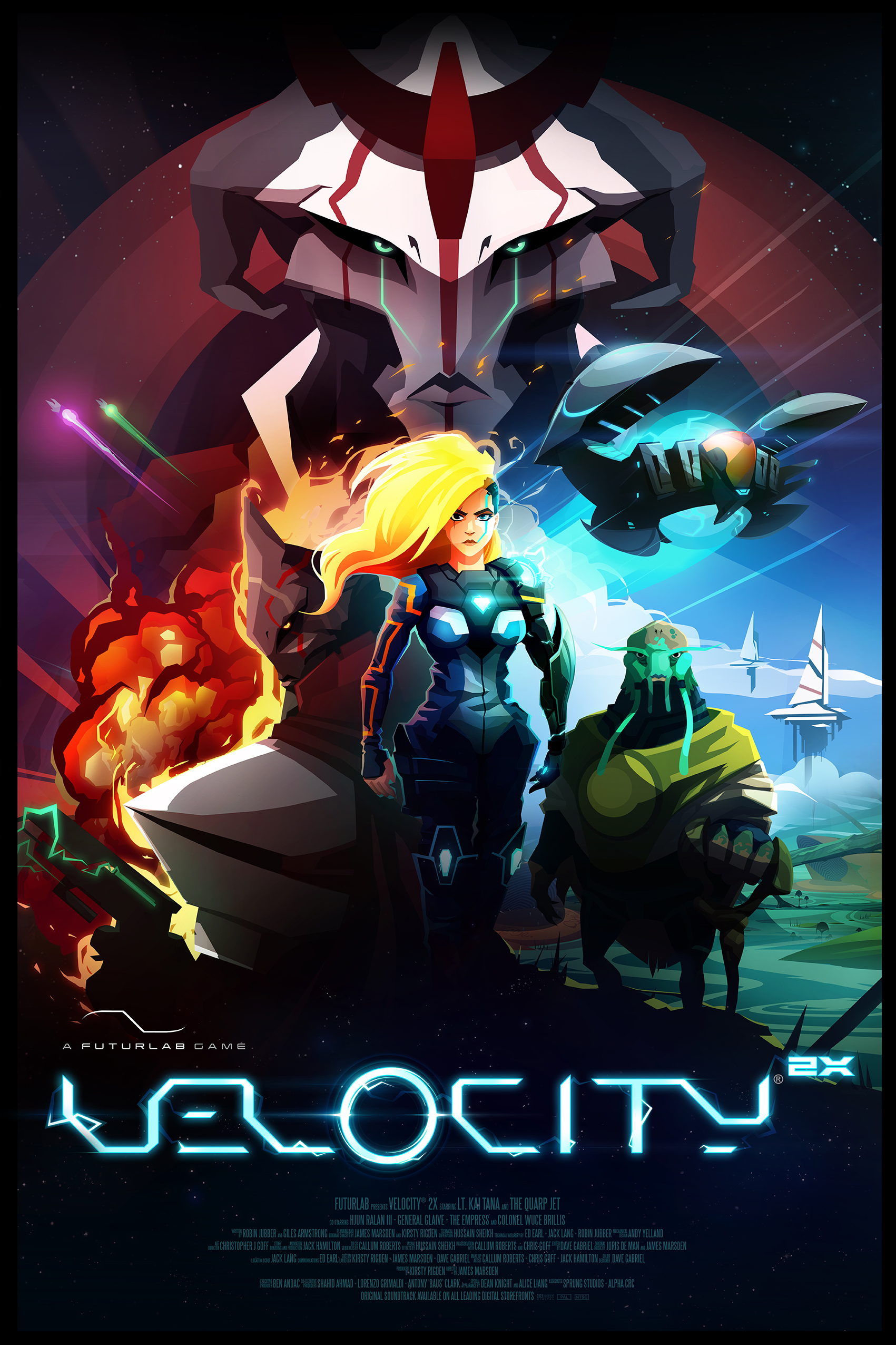
Velocity 2X Review (PSVita)

Velocity 2X
"Aw, Hell, yeah!"
What works
1. Everything is an improvement. 
The first Velocity game had a straightforward, NES-era sensibility to it, reminiscent of games like Metal Storm or Contra. The art direction and level design was simple, some might even say bland or samey, and enemy variety was a tad underwhelming, but it was cohesive and solid, everything fitting together perfectly. On top of that, it had very tight controls and unparalleled gameplay. It was almost perfect, hardly feeling like a Playstation mini
Velocity 2X might seem like it does very little to build on its predecessor, with many changes so subtle, they can be easily missed, and it's doubtful many will appreciate them. The artwork is still overall minimalistic with its textures and color palettes, but many levels have such fine details and subtle touches (like waterfalls that surprise you with a sense of height) that it's easy to get lost in the sheer beauty of certain spots.

2. Gunning and running. 
When I first saw the screenshots of the "on foot" segments, I was a little bit worried. It seemed like the step the folks at FuturLab took off the ship was a timid, cautious one that played it safe and checked with its neighbor. Frankly, it looked like an endless runner. Don't get me wrong, that would have made sense, and I love many of those games like Jetpack Joyride and Canabalt, but it would have felt like a token gesture toward expanding on the original concept. Luckily, I was so very wrong and I couldn't be happier about it. It is, in fact, a fully-realized sidescrolling platforming shooter with puzzles and exploration. There's even some combat and physics thrown in for good measure. It reminded me of Major Havoc with a touch of Metroid, all with the slick polish of WayForward's Bloodrayne: Betrayal. Kai Tana has extremely fluid and graceful animations, whether it's leaping across a disintegration field or firing her palm blaster (which makes me think of Vanessa Z. Schneider from P.N.03, a stylistically similar title I also happen to love) or even waiting for an elevator.

3. That certain... I don't know what. 
Actually, I do, but it's a little hard to describe. The short, crude version of it is: it makes you feel like a badass. Word is that the development team had to insist on a female lead even as far back as the first game, when we never left the ship. I, for one, am glad they stuck to their guns and delivered an awesome character who manages to be dead sexy, and does so on her own terms. When you're standing in a chamber of crystal deposits firing that hand cannon in a circle, shards of glass and debris falling all around you, it's hard not to let a smiling, "Aw, Hell yeah!" escape your lips. Before long, you're taking down Vokh patrols like it's second nature. You'll be flinging bombs at switches and turrets like you can see the future. You'll have distributing telepods down like a science. All, this, and you'll know it's you doing it, not some contextual action script set to Quick Time Events or button-mashing. That's a hard feeling to achieve, and this game nails it.

What doesn't work 
1. The side scrolling stages have room for improvement. 
It was often difficult to use the teledash while jumping or falling, and it would be nice if I could simply tap the screen rather than aiming exclusively with the controls. It would also be nice if your telepod inventory was separate from those you have for the Quarpjet (there's a notable size difference). I actually managed to just about break the game because I didn't realize I'd used up all my telepods back on the ship and got myself stuck. Of course, I could probably have backtracked to the ship, but since I didn't realize the inventory was shared, I thought it was a glitch. On that note, while the idea of the telepods to get through narrow hazards is great, it felt like I was having my hand held for far too long. At various points in the levels, there are these pads you're meant to stand on and aim your telepod at. I could understand these in the level wherein you're introduced to the mechanic, but having them throughout the game feels like there's no strategy to it.

2. Speaking of telepods... 
While micromanagement of telepods is vastly improved, namely the fact that you can retrieve spent pods through the map screen, the "shortcut" of hopping over to the last pod dropped by double-tapping the triangle button is a surefire way to get innards smeared across a bulkhead. At least two out of three tries caused me to drop two more pods where I stood. That double tap has to be just perfect, and I could never do it on command. The sidescrolling stages didn't have this problem, which makes me wonder if this could possibly be a runtime issue. 

3. Speed Pads Are Worthless. 
Velocity is a thinking man's shooter. In a game that already invigorates its genre by favoring pre-planning and exploration over twitch reflexes, having parts that railroad the player onto a fast track feels tacky. What's the point to the thrill of the added speed if you've got to be that much more alert with your teleporting? It's not even as though they're placed in strategic locations that would give you the best of both worlds if you were quick thinking enough to hit each one in rapid succession. To be fair, toward the end, one mission had them placed so close to upcoming walls that I had to resort to the old control method of teleporting, which was admittedly a nice touch. Still, I'd rather speed pads have been part of the DLC or bonus missions.

4. Mission 42 became the bane of my existence and nearly led to a ragequit. 
As great as touch controls are for teleporting across the map, it's not half as precise as it could be. I was convinced I'd found a bug because no amount of tapping could get me into a space after deactivating its force field. I restarted the level twice before I found out, practically on accident that the actual "'portable" area in the space is so small that even aiming the cursor with the analog stick felt like threading a needle on the roof of a speeding train.

But my absolute biggest gripe...
5. The calculator is not scientific. 

I mean, come on, guys. You know the Vita can handle it. Hell, the PSP could have done it (though the lack of a touchscreen would make things a bit tricky). I'm not looking for graphing capabilities or currency conversion or reverse Polish notation, I just want to know the spirit of the great warrior shaman SoCaToah is watching over me wherever I take my Vita.

What I'd like to see next. 
By favoring exploration, Velocity solves the problem of the Vita being widescreen. In typical SHMUPS, the gameplay favors verticality, with many arcade cabinets having their monitors mounted sideways. Velocity, meanwhile, started on the PSP, and therefore added a more pronounced X-axis to the movement repertoire. That said, I would love to see a version of Velocity that favors a vertical screen, namely a smartphone. Between Playstation Mobile and Playstation Now, I'd really love to see what Futurlab can do with more visual real estate.

Cooperative play may not be any sort of a game changer, but it may be a fun idea to explore. As a fan of The Last Starfighter (which, given some of your alien companion Ralan's lines, I think the developers are, too), it would be a great exercise in teamwork to relegate flying to one pilot with weapons and teleporting to a co-pilot.

22 June 2014

Oh, Twitter...

I love Twitter, flaws and all. I don't think it's the greatest site ever made, but it's easily in my Top 5. Lately, though, I've been having a bit of a rough time with it. 
My Xperia Z Ultra has been great, even if I'm only using it as a tablet as my contract with Verizon won't run out for at least another month. To ease the transition, I culled a number of apps from my old phone, the HTC Rhyme. It had been getting a bit bloated, and many of those apps work far better on the Ultra. One of the apps I removed early on was Twitter. Technically, I still have it on the Rhyme, it's simply not the full version, but HTC's dashboard version, Peep. Peep works fine and dandy, but I didn't realize how stripped down it was compared to its big brother. 
I access Twitter primarily through Tweetdeck. It has its own separate login and account settings apart from my Twitter account proper. As for logging in to Twitter, I'd recently upped the security on it in light of some recent bouts with identity theft and set up mobile notifications. If I log in to Twitter from any new place, I have to enter a code that gets sent to my phone as a text message. 
What I didn't know until now was that when I removed Twitter from my Rhyme, I kept it from receiving those login codes. I figured that since they were only text messages, whether or not the app was present was totally irrelevant. Now, if I try to log in to Twitter through my browser (or especially the Z Ultra) I can't because I don't receive codes anymore. The solution seemed simple: put Twitter back on the Rhyme and get the codes. 

Guess what I have to put in when I open Twitter on the Rhyme. 

It's actually an easy fix, simply a matter of finding another way to log in, but it's so absurd that it's set up in this manner. I'm entering a phone number, not a MAC address, so why does the app need to be present in order to get a text message? What if I didn't have a smartphone, but an old flip phone (or "feature phones" as T-Mobile calls them, or "dumbphones" as everyone else calls them), like if I had to move my SIM card to another phone because of damage? What if the app got corrupted and needed to be reinstalled? For all intents and purposes, that's exactly what's happening now. 
There's nothing more frustrating than a security measure that works too well. It's like when your kid beats up the school bully: You want to give them a high five for kicking ass and not taking any crap, but you want to scold them as much for fighting fire with fire. 

16 February 2012

Quartet of Qontent... Content.

A curious thing happened this past week; not only did I produce a video, I produced four in about as many days. It all started with me getting ready for a sketchbook project that's nearing completion whereupon I'll film the final product as opposed to scanning it. Next, I came upon a video of Mike Matei demonstrating the painfully meticulous inking process for the title card of the Angry Video Game Nerd's Star Wars episode. Someone in the comments cheekily asked about the potential of making a mistake, and that led to me making the first video Ink is My Pal. It was the first time I'd ever filmed myself with my Sony Cybershot H55, and I realized just what a complete technical moron I can be at times*. As such, I turned the trials and tribulations into the next three videos so that not only will I not repeat the mistakes I made, but others can hopefully learn from them as well.
Fair warning/cop-out: These are rather "quick & dirty" as videos go; they're rushed, half-scripted/half-improvised, and edited entirely using YouTube's new built-in editor, which essentially stands somewhere between a typical Linux video editor and iMovie. Polish wasn't the point, however; it was making as many videos as I could in a short amount of time and getting past my usual meticulousness and perfectionism in favor of just making some damn content. My more fiction/narrative/abstract works, by contrast, I hope will be a little more refined and at least look like more effort's been put into them.


*See, I've made videos since at least high school, where I worked on the morning's televised announcements and produced a number of news stories and sketches. However, while that may sound like a robust regimen of working experience, the fact is that I left all the technical stuff to other people. Instead, I focused on scripting, storyboarding, and (minimally) editing. I ended up acting a little more than I wanted to (thankfully in Voiceover, with which I'm far more comfortable given my radio-face), and rarely operated the camera beyond simply pushing the record button every now and then. 

20 February 2010

Housekeeping

First, as my old Video Art professor would say, some housekeeping: tomorrow I leave for Albuquerque. As such, my Twitter page will be my only means of making updates. I'm going by train, and that's for three reasons:
1. The FAA is run by lemurs who take turns driving nails into each other's heads.
2. Said nails are apparently made of gold, hence the absurd ticket prices and fees.
3. It takes as long, and costs at least the same as driving (if not less on both counts).
In any case, I'll have a lot of free time. Thankfully, I've got my unabridged audiobooks of 2001: A Space Odyssey and The Fountainhead to pass the time, along with my PSP. I've got Final Fantasy Tactics: War of the Lions, and I'm going to try my damnedest to get some enjoyment out of it this time.

After a little soul-searching, I decided to renew my pro account over at Flickr. At first, I was apprehensive for three reasons:
1. I'm not really making that many photographs right now.
2. I'm broke.
3. I was spending more and more time on DeviantART.

Now, however, I'm still going to be spending most of my free-time on DeviantART, but since I'm not going to renew my premium membership (unless substantiated third-party "permission issue" reports are given the same validity and treatment as DMCA reports), that resolve did give me a little financial leeway (enough for 24 months instead of 12). In short, I'm going to support Flickr because they know how to run their site and listen to their users.

Also, I found out that a non-pro account with Flickr is a little more restrictive than I'd thought; instead of just limiting the number of sets you can display and photos/videos you can upload within a month, they also limit your photostream to your 200 most recent photos. That was a real shocker to me; in fact, there was an honest moment of panic that over 400 of my pictures had been lost. Luckily, they are stored, and by pruning a few of my more recent images, the older ones take their place.

Flickr was sort of my first love before Becca-chan persuaded me to join DeviantART. My Nikon s50c came with 3 months of FlickrPRO, and I was hooked for the next two years. It's a good and strong community, if spread a little thin, and I really love how in touch the site's creators are with their users. I've harped about this before, I know, but I still consider the way they handled introducing video uploads to be an act of pure genius. It's just clear they put a lot of thought into it before going public, and were very receptive to feedback both before and after launch.

That's another reason I reinstated my FlickrPRO account; I want to help get the Video community more recognition. Although it's a nice video community, I feel like no one's really given it a chance and people are very slow to warm up to it. Most videos are lucky if they get more than 100 views, and I don't think I've ever seen a video with views counting over 1,000. So, I want to do what I can by uploading a few more videos (I posted my Pattern 158 animation there first before posting it and the rest of the trilogy here) to my photostream. I haven't decided what they'll be just yet. I'm just fascinated by the 90-second time limit; I take it as a challenge. It makes me think of how, in my video art classes at UNM, we'd have assignments with one, three, or five-minute time limits, and yet despite repeated emphases on length, someone would always have a ten or even thirty-minute "magnum opus" on the due date. Sure, we would still watch it and maybe even give a fair critique at the end, but it was obvious that, despite any praise or comment, what most of us really wanted to say was "Really? You couldn't keep THIS under 5 minutes? Are you THAT in love with yourself?" In our defense, it wasn't out of complete impatience; one of my really good friends always delivered these technical and artistic masterworks that were, by contrast, criminally short, like 10 or 15 seconds (including titles and credits). I swear, one time at least five of us simultaneously let out variations of "damn it" when one of his pieces ended. I can appreciate that a project can start as a small idea and then grow over time into something bigger, but when that happens, you're really supposed to put that project on the backburner or produce it in parallel to a new, but shorter, project.

Anyway, that's the news for now. I've got a few more journal entries waiting in the wings that I'll post once I get back around next Sunday.